Translate

March 31, 2016

Artists Worry About Creeping Censorship in Hong Kong

by Liang Zhen, Epoch Times

China – The Epoch TimesToday, 17:48
Candace Chong Mui-ngam, spokesperson of Artists Action, said that the government’s response failed to allay doubts, and members were concerned that further intervention would affect and infringe on artistic freedom. (Cai Wenwen/The Epoch Times)

Many artists were shocked and concerned over censorship issues when Hong Kong’s Leisure and Cultural Services Department (LCSD) made a controversial request to delete the word “national” from the name of a Taiwanese university in a theatrical troupe’s performance booklet.

The LCSD asked the theatre company “The Nonsensemakers” to delete the word from the resume of a member who graduated from the Taipei National University of the Arts.

Secretary for Home Affairs Lau Kong-wah spent two minutes reading a press release about the topic at a press conference on March 22. Then he left immediately without answering reporters’ questions.

The Leung Chun-ying administration continued to shy away from the issue on March 23. When questioned by reporters that day, Chief Executive Leung Chun-ying was largely evasive and only spent 10 seconds responding to the queries.

Curtailing creative freedom
Candace Chong Mui-ngam, spokesperson of the interest group Artists Action, was concerned about further intervention from the government and whether this would lead to self-censorship, since most of the production costs come from government funding.

“Artists themselves start to worry,” said Chong. “Some things cannot be said, while some things need to be said with caution.”

In her capacity as a playwright, Chong said that censorship has never been an issue for her in the past, and hearing about the “no national” incident came as a shock.

She said Hong Kong’s political climate and the curtailment of freedom of press in Hong Kong are worrying trends, and she was concerned about this shadow spreading to the theatre.

“The theatre is a good platform to reflect various social events, and currently its content has not met with intervention,” said Chong.

She added that the incident had a negative influence, and she hopes to maintain the valuable space of creative freedom.

Meanwhile, Chan Chu-hei, artistic director of Theatre Horizon, said that his company is funded by the Arts Development Council (ADC). Each year the ADC will fund one programme, and this is quite important to every theatre company, he said.

Chan said he currently does not face any pressure content-wise. However, when asked how he would handle it if faced with a similar incident, he said he would be in a dilemma because of restrictions of the contract.

Joseph Wong Wing-ping, the former secretary for the civil service, suggested in a newspaper column that Lau should clarify who prohibited the use of “national” or similar wording, and how to handle similar incidents in the future in order to avoid self-destroying the “one country, two systems” principle in Hong Kong.

Translated by Benjamin Ng. Edited by Sally Appert

http://www.theepochtimes.com/n3/2009323-artists-worry-about-creeping-censorship-in-hong-kong/

Manila declines to comment on Taiwan's invitation to Taiping Island

Latest | FOCUS TAIWAN - CNA ENGLISH NEWSToday, 17:40

Manila, March 31 (CNA) The Philippines declined to comment Thursday on an invitation by President Ma Ying-jeou (馬英九) to send Philippine government representatives or lawyers to visit Taiping Island, which Taiwan claims as its territory, in the contested South China Sea.

"We have no comment on the invitation," said Charles Jose, spokesman of the Philippines' Department of Foreign Affairs, in response to an inquiry by CNA.

On the nature of Taiping (also known as Itu Aba), the Philippines has asked the Permanent Court of Arbitration in The Hague to determine the nature and character of different features in the South China Sea, he said.

"We will leave it to the tribunal to make that determination," he added.

A Philippine analyst said that Manila will not change its stance on Taiping, whether it sends a representative to Taiping or not, adding that making no comment on Taiwan's invitation and saying it will wait for the tribunal's decision is a feasible way of responding.

The Philippine official's remarks came after Ma on March 23 invited the Philippines to send government representatives or lawyers to visit Taiping, so that they can see for themselves that it qualifies as an island rather than just a reef.

The invitation came amid questions about whether the 0.51-square-kilometer Taiping, the largest of the Spratly Islands, can be defined as an island under international law.

A case pending in the Permanent Court of Arbitration brought by the Philippines against China, has triggered interest in how the landforms in the South China Sea should be defined.

Manila is hoping the court will rule that many of the formations claimed by Beijing in the South China Sea are no more than reefs or rocks, and therefore entitled to no more than 12 nautical miles of territorial waters, rather than islands, which generate 200-nautical-mile economic zones.

Such a ruling would negate many of China's claims to fishing or resource rights in the region.

Taiwan has taken an interest in the case because a lawyer for the Philippines has argued that Taiping is not an island but rather a rock that cannot support human habitation.

In an effort to seek international support for its stance that Taiping meets the definition of an island, Taiwan's Ministry of Foreign Affairs arranged for a group of local and international journalists and experts to travel last week to Taiping, which lies about 1,600 kilometers southwest of Kaohsiung, southern Taiwan.

Taiping has its own sources of natural, abundant, potable fresh water, as well as naturally formed and fertile soil, while fruit, vegetables, chickens and goats are raised there, providing ample evidence that it is fit for human habitation and can support an economic life of its own, the ministry said.

Taiwan, China, the Philippines, Vietnam, Malaysia and Brunei claim all or part of the islands and reefs in South China Sea, where are thought to be rich in oil and natural gas reserves.

(By Emerson Lim and Elaine Hou)
ENDITEM/J

http://feedproxy.google.com/~r/rsscna/EngNews/~3/stDjmw8Jw3g/201603310020.aspx

Apple Daily left red-faced over unauthorized Gregory Rivers ad

EJ InsightToday, 16:16

Gregory Charles Rivers posted the offending advertorial on his Facebook page (inset), saying it was made without his permission. Photo: HKEJ, Gregory Rivers/Facebook

Gregory Charles Rivers posted the offending advertorial on his Facebook page (inset), saying it was made without his permission. Photo: HKEJ, Gregory Rivers/Facebook

Apple Daily has been forced to apologize after running an advertorial featuring a renowned Hong Kong-based Australian artist who disavowed it. 

The newspaper said none of its editorial staff was involved but held an employee from its classified ads department responsible after an internal investigation.

The employee has been suspended, according to media reports.

The investigation followed a Facebook postby Gregory Charles Rivers (河國榮) in which the 50-year-old Australian performer complained about being used in an advertisement without his permission.

Rivers said he was approached in February to do an interview with Apple Daily in Jini Bakery Cookies, a local bake shop, on March 7.

He was to be paid HK$2,000 (US$258) for expenses.

He went to the venue on the appointed day and was quickly made to pose inside the shop by a photographer.

Rivers repeatedly asked the photographer if the photos were going to be used in an article or in an advertorial and was told these were for the interview, according to news website hk01.com.

The interview lasted five minutes but Rivers said he did not check the media credentials of the interviewer who asked just three questions. 

The photographer did not say whether they were from Apple Daily.

On March 20, Apple Daily ran a full-page spread of Jini cookies with Rivers’s image and it was marked “advertorial”.

A day earlier, the bake shop published a photo of Rivers on its Facebook page, along with a note thanking him for “dropping by”.

The post was subsequently removed.

Netizens flooded Jini’s social media pages with angry comments and expressed their support for Rivers.

Jini Bakery Cookies has been dismissed as a copycat version of Jenny Bakery, a popular pastry shop which operates in Hong Kong, Singapore and mainland China.

– Contact us at english@hkej.com

DY/AC/RA

http://www.ejinsight.com/20160331-apple-daily-left-red-faced-over-unauthorized-gregory-rivers-ad/?utm_source=rss&utm_medium=rss&utm_campaign=20160331-apple-daily-left-red-faced-over-unauthorized-gregory-rivers-ad

New twist in cement murder case: Hong Kong police arrest girlfriend of suspected victim

Officers also nab man whose staff card was found at crime scene, bringing total number in custody to five

CLIFFORD.LO@SCMP.COM

UPDATED : Thursday, 31 March, 2016, 4:21pm

Cheung Man-li’s phone records led the Hong Kong Island regional missing persons unit to the flat in Tsuen Wan. Photo: Edward Wong

In a new twist to the case of the decomposing body found in a cement-filled box, the girlfriend of the missing man thought to be the victim has been arrested in connection with the murder, the Posthas learnt.

Officers investigating the gruesome discovery believe Cheung Man-li, 28, who was reported missing on March 6, was killed when he went to a Tsuen Wan industrial unit to demand the payment of a HK$1 million debt on March 4.

“We believe the body was placed on a mattress and fenced with four wooden pieces before tape was wrapped outside,” a source with knowledge of the investigation said.

Police believe cement powder was poured inside this makeshift box before a mixture of cement and water was added to form a block one metre long, one metre wide and half a metre tall.

It took firefighters several hours to crack open the cement and retrieve the badly decomposed body on Tuesday night.

Cheung’s girlfriend, 26, who had earlier reported him missing, was picked up by officers at her home in North Point on Wednesday, the source said. A 26-year-old man, whose staff card was found in the flat where the body was discovered, was nabbed in Ngau Tau Kok on Wednesday night.

The latest arrests were made hours after police picked up another three suspects – two men and one teenage girl – in connection with the case. All five Hongkongers, aged 16 to 26, were arrested for conspiracy to commit murder. As of 1pm on Thursday, the suspects were still being held for questioning and had not been charged.

Cheung was last seen entering the Fui Yiu Kok Street industrial building in Tsuen Wan on March 4. His body was found in a ninth-floor industrial unit which was being used as a residential flat occupied by a 27-year-old man and his girlfriend. The pair were Cheung’s friends.

Security camera footage from March 4 showed a trolley loaded with bags of cement being pushed into the building by a man in his 20s.

According to police, the victim has not yet been identified, but clothes found on the body matched those worn by Cheung.

Police are still hunting for the two tenants of the flat and the man who delivered the cement.

“Initial investigations indicate the male tenant and his girlfriend had fled Hong Kong in the middle of this month,” another source said, adding that the pair had allegedly left for Taiwan.

The source said officers had to discuss the case with colleagues from the force’s liaison bureau before deciding on whether they should seek help from the Taiwanese authorities.

While Hong Kong has signed agreements for the surrender of fugitive offenders with countries such as the United States, Britain and India, it still has no formal extradition agreement with mainland China, or with Taiwan or Macau.

The grisly details of the case first emerged on Tuesday when officers from the Hong Kong Island regional missing persons unit checked Cheung’s phone records and discovered that the Tsuen Wan flat’s tenant was one of the last people he had been in contact with.

http://m.scmp.com/news/hong-kong/law-crime/article/1932307/new-twist-cement-murder-case-hong-kong-police-arrest

Hong Kong mother convicted of assault on teacher outside son’s school

The housewife slapped the woman 10 times and pushed her to the ground

EDDIE.LEE@SCMP.COM

UPDATED : Thursday, 31 March, 2016, 3:27pm

Xie Hui-juan leaves the Kwun Tong Court after hearing the sentence. Photo: Nora Tam

A mother of two who, in a fit of rage, slapped her son’s teacher 10 times and pushed her to the ground outside the school, was given a four-month suspended sentence on Thursday.

Convicting Xie Huijian of assault at Kwun Tong Court, magistrate Don So Man-lung noted she had stopped taking medication for psychiatric illness because she was breastfeeding, which contributed to her anger.

The 38-year-old housewife launched the attack last October after questioning the teacher’s earlier refusal to allow her 10-year-old son to take a rest at his Kwun Tong school.

Xie fled the scene following the attack, and other staff members called the police. The mother was later arrested at her home.

In mitigation, Xie said she admitted wrongdoing. She added that she needed to care for her children, one of whom was born less than two years ago.

In handing down the sentence, So told Xie she had committed a serious offence.

“Under normal circumstances, such an offender should be put behind bars immediately,” he said.

But the judge noted that the mother was suffering from psychiatric illness and had stopped taking medicine to breastfeed her newborn baby for a time, during which the attack took place.

“The sudden act of violence was somewhat triggered by this,” So said.

“The likelihood of repeat offending is low after she stopped breastfeeding.”

http://m.scmp.com/news/hong-kong/law-crime/article/1932312/hong-kong-mother-convicted-assault-teacher-outside-sons

Why Beijing is taking HK National Party seriously -by SC Yeung

EJ InsightToday, 14:21

Chan Ho-tin, convenor of the Hong Kong National Party, is advocating the creation of an independent republic. Photo: RTHK

Chan Ho-tin, convenor of the Hong Kong National Party, is advocating the creation of an independent republic. Photo: RTHK

Beijing appears to be sufficiently alarmed by the formation of Hong Kong National Party, which is advocating the creation of an independent republic and the repudiation of the Basic Law.

The SAR government promptly rejected the group’s application for registration, warning that calling for independence is a violation of the Basic Law, the city’s mini-constitution.

However, official condemnation of the group has only made it well-known over a period of just a few days after its establishment was announced on Sunday.

In fact, attacks on the group have fueled discussions about Hong Kong independence, prompting many people to consider the concept of independence as an option for the city as China tightens its grip on the territory.

A spokesperson for the Hong Kong and Macau Affairs Office strongly opposed any action related to Hong Kong independence, stressing that the Hong Kong SAR is part of the People’s Republic of China under the Basic Law, and the principles of “one country two systems” and Hong Kong people ruling Hong Kong with a high degree of autonomy.

In an interview with the state-owned Xinhua news agency, the spokesperson said “an extremely small number of people” have formed a pro-independence group, “threatening the national sovereignty and safety, as well as Hong Kong’s stability, prosperity and basic interest”.

Such action, the spokesperson said, is “firmly opposed by all Chinese nationals, including some seven million Hong Kong people”.

“It is also a serious violation of the country’s constitution, Hong Kong’s Basic Law and the relevant existing laws.”

The office said the SAR government would handle the matter according to the law, and praised it for refusing to register the group.

Also on Wednesday, the official Global Times dismissed the National Party’s founders as “mere attention-seekers who want overnight fame”.

The paper said the idea of Hong Kong becoming independent is “completely unrealistic”, and called on Hong Kong people to simply ignore the group.

In a way, Beijing’s reaction was completely understandable and expected.

In a place where there is no freedom of expression, where people have long lived under authoritarian rule, any concept that goes beyond the official line is considered treason, an outright rebellion.

But for Hong Kong people, the discussion of a topic such as Hong Kong independence should be protected by our laws. Hong Kong, after all, highly values its freedom of expression and thought.

That’s why we find it quite strange for the administration of Leung Chun-ying to issue a statement echoing Beijing’s official stance on the issue, warning that it “will take action according to the law”.

However, the government did not say which law it is referring to.

Even local legislators said the government would be hard put to find an appropriate law to sue the National Party’s members for advocating independence.

Beijing is correct in saying that Hong Kong National Party is only a small group.

Not only that, it is composed mostly of university students and other political neophytes, just like Youngspiration and Hong Kong Indigenous.

Though lacking in support from established politicians, these groups have proved their strong influence among the youth in the district council elections in November last year and the Legislative Council by-election for the New Territories East last month.

In the by-election, for example, Hong Kong Indigenous candidate Edward Leung was able to secure more than 15 percent of the votes.

What apparently worries Beijing and Hong Kong officials is the profile of his supporters, which could provide some insight into the possible outcome of the Legislative Council elections in September.

Data provided by the electoral office shows that Leung’s votes mostly came from traditional public estates in Tseung Kwan O, Tai Po as well as the Northern District.

The top 10 polling stations where Leung secured the highest votes shared the same characteristic, which is the higher than average number of voters born after 1990.

For example, in the polling station of Sheung Tak Estate in Tseung Kwan O, voters born after 1990 accounted for 23.1 percent, while in other polling stations, they accounted for 12 percent.

That indicates that most of the supporters of radical democrats with independence leanings were first-time voters.

This means that most of the young voters have a tendency to support Hong Kong independence, and this is what Beijing authorities are most worried about.

However, Beijing’s hard-line stance on the issue could only encourage more youngsters to register to be able to cast their votes in the September elections.

Based on the Edward Leung’s 15 percent vote benchmark, it cannot be ruled out that radical young democrats can secure seats in the five geographical constituencies in Hong Kong, or five seats in total.

Hong Kong National Party may just be an appetizer in the emerging campaign for Hong Kong independence.

There is also a political party being formed by Scholarism stalwarts Joshua Wong, Agnes Chow and Oscar Lai, which will be announced in mid-April.

The new party has identified Hong Kong’s future after 2047 as its key advocacy, which is probably another way of saying that they will focus on the issue of Hong Kong independence.

The three Scholarism stalwarts have deep experience in political struggle and enjoy massive support from the youth, so it is expected that their new party will be at the forefront of the discussion on independence.

It’s highly likely that Beijing’s stern warning against Hong Kong National Party is actually directed at Joshua Wong and his new party.

– Contact us at english@hkej.com

SC/AC/CG

http://www.ejinsight.com/20160331-why-beijing-is-taking-hk-national-party-seriously/?utm_source=rss&utm_medium=rss&utm_campaign=20160331-why-beijing-is-taking-hk-national-party-seriously

Lee Bo saga: Why the suspicions will remain

by Joseph Wong Wing-ping

EJ InsightToday, 15:09

A file photo shows protesters waving photos of Lee Bo outside Beijing's liaison office in Hong Kong. Despite his denials, many suspect that the bookseller was abducted by mainland secret agents. Photo: AFP

A file photo shows protesters waving photos of Lee Bo outside Beijing's liaison office in Hong Kong. Despite his denials, many suspect that the bookseller was abducted by mainland secret agents. Photo: AFP

Bookseller Lee Bo (also known as Lee Po) has been allowed by mainland authorities to travel back to Hong Kong.

During his first trip to the city last week following his three-month-long disappearance, Lee requested the local police to withdraw a missing-person investigation on him.

Before that, he claimed in pre-arranged interviews with Beijing-friendly newspapers that he went to mainland China “on his own accord”, and that, as a Chinese national, he feels “obliged to assist in an investigation”.

Now Lee has even decided to wind up his publishing business for good, purportedly saying that all the books he sold were “tabloid and full of fabricated slanders” and that Hong Kong’s freedom of speech “can never be the shelter for rumors and slanders”.

Lee told the police that he went to the mainland on his own “with the help of some friends” and that his disappearance “had nothing to do with abduction or hijacking”.

Yet his lips remained tight as to the details of how exactly he crossed the border.

Senior Counsel Winnie Tam Wan-chi, chairwoman of the Hong Kong Bar Association, told Cable TV on the same day of Lee’s return that the unaddressed mystery shrouding Lee’s disappearance has made the incident “the most disturbing one since Hong Kong’s handover”.

“Anyone with an average level of intelligence will find the recent developments have led to more questions than answers,” she said.

In a separate TVB interview, Tam said Lee may have been intimidated and that he is afraid to speak the truth.

And, the incident, with all the dubious theories to explain it away, have “impaired Hong Kong’s core values, in particular freedom of speech and freedom of the person, head-on”, she said.

Despite the doubts and concerns among many observers, we have heard calls from the pro-Beijing camp that we should lay the matter to rest, given Lee’s return.

Legislator cum Executive Councilor Ip Kwok-him said: “Since Lee has stressed he was in no way forced to the mainland, people who are willing to believe will believe Lee’s words.”

Former Legco president Rita Fan Hsu Lai-tai, now a member of the Chinese legislature’s standing committee, also said she buys Lee’s words and that there is no evidence of law enforcement by mainland agents in Hong Kong.

Theories like abduction are “sheer speculation”, Fan said. “If you still do not believe what Lee has said, then I cannot convince you either.”

The reality on the ground is that most Hongkongers feel jittery and skeptical but “smart people” like Ip and Fan still choose to believe whatever Lee says in front of the camera.

More than once did Lee hint that some friends “helped” him in the cross-border travel. This is why we doubt if he really volunteered to go there.

Suspicions will remain unless we know who “helped” Lee and exactly how they helped him.

Beijing, in a bid to assuage the ruffled feelings of Hongkongers, has again said that there is no change in its policies with regard to Hong Kong.

Wang Guangya (王光亞), the head of the State Council’s Hong Kong and Macau Affairs Office, took the initiative to convey the same message to Hong Kong journalists at this year’s NPC session.

However, when questioned by foreign reporters, Beijing’s response is always like this: “Mind your own business”.

Is Beijing aware that honesty is the best policy?

As for Lee, having fulfilled his obligation as a Chinese national to assist in an investigation, is he aware that he has another obligation, as a Hongkonger, to give a full account of the incident to all of us?

I have a sinking feeling as to whether the truth will ever come out: while Lee is tight-lipped, there will be more Beijing yes-men who will join Ip and Fan and urge Hongkongers to stop demanding answers.

Before long the police will also end its investigation with the excuse that it cannot find any proof that any law has been violated or circumvented.

The chief executive may then wrap up the entire issue with some hollow reiteration that only local law-enforcement agencies have the legal authority to enforce laws in Hong Kong.

In all this, the only thing that could become apparent is that Hong Kong’s freedom of speech and autonomy and individual liberties will remain only on paper.

There will be no more books of “fabricated slanders”, and people will become wiser and more obedient in order to play it safe.

This article appeared in the Hong Kong Economic Journal on March 30.

Translation by Frank Chen

[Chinese version 中文版]

– Contact us at english@hkej.com

RC

After going missing for weeks, Lee returned to Hong Kong suddenly and insisted that he went to the mainland on his own volition. Photo: Internet

http://www.ejinsight.com/20160331-why-we-need-clear-answers-on-lee-bo/?utm_source=rss&utm_medium=rss&utm_campaign=20160331-why-we-need-clear-answers-on-lee-bo

United Daily News: Reconsidering industrial policy from OBI case

Latest | FOCUS TAIWAN - CNA ENGLISH NEWSToday, 13:47

President-elect Tsai Ing-wen (蔡英文) described five key industries of the country during her election campaign, which are biological technology, green energy, the Internet of Things, national defense and machinery.

After winning the election on Jan. 16, Tsai embarked a so-called "industry tour" to several industrial clusters. During the trip, she declared again her industrial policy, which will center on the development of those chosen industries.

However, Tsai has never elaborated on the reasons why she selected these specific industrial clusters for her industry tour.

It is not without reason to say that the new government's theory for picking the country's future industrial pillars needs to be improved. For example, green energy was designated as one of Taiwan's "six emerging industries" seven years ago by then-Premier Liu Chao-shiuan (劉兆玄).

Liu's Cabinet allocated funds to the tune of NT$6 billion (US$168 million) each year for its energy-centered national projects. However, over the past seven years, Taiwan's development of green energy has been conducted at a snail's pace. No substantial progress has been seen in the areas of extracting energy from tides, heat underground, sunlight, offshore wind, or methane hydrates.

We believe that if planning to promote a policy that a predecessor has failed to achieve, the new government should be able to explain why its methods are better and will achieve success.

Aside from its lack of theory, what it is about Tsai's industry tour that is of greatest concern is its role in the areas of political-business collusion and benefit transfer.

From the recent controversy surrounding publicly listed biotech company OBI Pharma Inc. (浩鼎), people have begun to question Tsai's endorsement of the development of the biotech sector and her entire industrial policy.

While the president of prestigious Academia Sinica remains embroiled in a scandal involving sales of OBI stocks, how can Tsai's family, her policy-planning team and her assistants who planned the industry tour earn the trust of the people that they have not benefited from Tsai's policy?

If the OBI case can light up the blind spots in the new government's industrial policy, prompting the incoming government to re-think and take measures to mend the holes, it will perhaps be the only positive outcome of the case. Editorial abstract, March 31, 2016

(By Elizabeth Hsu)
ENDITEM/J

http://feedproxy.google.com/~r/rsscna/EngNews/~3/-TQ6Hr6X9Rc/201603310010.aspx

Hong Kong’s Most Popular Recent Leader? The Last British Governor -by Aris Teon

The NanfangToday, 11:25

Aris Teon March 31, 2016 11:25am

According to the latest survey of the Public Opinion Programme of the University of Hong Kong (HKU POP), Chris Patten, the last British Governor of Hong Kong, enjoyed the highest ratings among political leaders of the city in the past 24 years.

Chris Patten was a member of the British Parliament with the Conservative Party from 1979 until 1992, when he lost his Bath seat at the general election (Chris Patten: East and West. Pan McMillan 2012, p. 13). British Prime Minister John Major offered him the post ofGovernor of Hong Kong. Patten’s term of office as Governor lasted until 30 June 1997, whenHong Kong was handed over to the People’s Republic of China.

The POP survey, released on March 29, shows that upon assuming office Chris Patten’s rating was approximately 55% and at the end of his term in June 1997 it was 60%.

After the handover and the establishment of the Hong Kong Special Administrative Region (HKSAR). the office of the Governor was replaced by that of the Chief Executive. From 1997 to the present Hong Kong has had three Chief Executives: Tung Chee-hwa (董建華, 1997-2005), Donald Tsang (曾蔭權, 2005-2012) and Leung Chun-ying (梁振英, 2012-present).

The POP survey shows that the ratings of all three Chief Executives upon assuming office were either the same or higher than Chris Patten’s: Tung Chee-hwa 65%, Donald Tsang 73% and Leung Chun-ying 53%. However, their ratings declined during their term of office: Tung Chee-hwa 48%, Donald Tsang 39% and Leung Chun-ying 39%.

The post Hong Kong’s Most Popular Recent Leader? The Last British Governor appeared first on The Nanfang.

https://thenanfang.com/hong-kongs-popular-recent-leader-last-british-governor/

Is Suu Kyi way the way for HK democracy movement? -By Chris Yeung

Voice of Hong KongToday, 08:05

By Chris Yeung –

History is in the making in Myanmar on Wednesday as Htin Kyaw, a close friend and confidant of Aung San Suu Kyi, is sworn in to become the first head of state since 1960s without military background. It marks a milestone in the decades-long crusade of Suu Kyi, a Nobel peace prize laureate, for democracy.

Though barred from becoming president by a constitution tailor-made for the military to hold on to power, Suu Kyi has taken four cabinet positions including that of foreign minister. She has vowed to steer the government after the landslide election victory of the National League of Democracy she led in November.

The hard-earned success of the 70-year-old democracy fighter has impressed and inspired aspirants and supporters of democracy and political pundits in different parts of the world.

One of them is Shih Wing-ching, founder of the Centaline Property Agent and a free Chinese-language daily AM730 in Hong Kong. In his regular newspaper published on Wednesday, Shih said Hong Kong people have a lot to learn from Suu Kyi in fighting for social, political reform in the city.

What lesson to learn? Shih said democrats in Hong Kong should take reference to the choice of Suu Kyi in making progress on social change on a piecemeal basis towards its completion. “Otherwise, political struggle will never come to an end; people will never enjoy a peaceful life.”

Shih said there is no denying the existing constitution scripted by the military government is fraught with unfair provisions including a ban for anyone whose spouses have foreign nationality from becoming president.

Since Suu Kyi’s NLP has grabbed more than 80 per cent of votes in the November elections, she should have become the president. But for the constitution to be amended, the process of it will be extremely complicated and there will be conflicts with the army and chaos, Shih has argued.

He wrote Suu Kyi would certainly win support from the people if she decided to raise the issue of amendment of the constitution. But as the military holds a de facto veto against amendment of the constitution, she will have to overthrow the junta government through armed rebellion. The cost to be paid by the people will be huge, he said. “Suu Kyi has not hastily thrown down the gauntlet as the militants in Hong Kong did.

Shih said: “Suu Kyi knows clearly the existing constitution is biased in favour of the military. One quarter of seats of the parliament is set aside for the military. Some cabinet posts can only be filled by up the army… One of the two vice presidents must come from the junta.

“According to the standard of the Hong Kong democrats, such an election is unacceptable. The extent of such election being biased in favour of the military is even greater than that of the functional constituency elections towards the pro-establishment force.

“But Suu Kyi has not boycotted the election and roundly attacked the government by claiming the high moral ground. On the contrary, she seized the opportunity of a relatively more open election for her party to take part so that people can express their wish through their ballots.

“Myanmar is able to take a big step forward in democracy because Suu Kyi is not just full of ideals, but ideas of strategy that meet the reality. Hong Kong democrats should learn from Suu Kyi,” Shih said.

HK pan-democrats veto ‘fake universal suffrage’ blueprint

Though without specifying, Shih was clearly referring to the failure of the 2015 political reform, which was aimed to introduce universal suffrage for the 2017 chief executive election. The government blueprint, which was based on a set of rules dictated by Beijing, was rejected by the pan-democrats. They accused the blueprint as “fake universals suffrage” and insisted not to “pocket it first.”

Following the reform fiasco, the issue of universal suffrage has faded away from the city’s political radar screen because the earliest possible time for a popular vote for the SAR top leader will be 2022, which is too remote.

But when the issue of universal suffrage returns to the political agenda, Hong Kong people will be confronted with the same question they and Suu Kyi had faced: take a less ideal package or wait for a better deal.

Chris Yeung is founder and editor of the Voice of Hong Kong website. He is a veteran journalist formerly worked with the South China Morning Post and the Hong Kong Economic Journal. He writes on Greater China issues.

Photo: Picture taken from National League of Democracy Facebook

Let your voices heard: Should Hong Kong learn from Aung San Suu Kyi’s fight for democracy? If yes, how? Write to vohk2015@gmail.com

http://www.vohk.hk/2016/03/31/is-suu-kyi-way-the-way-for-hk-democracy-movement/?utm_source=rss&utm_medium=rss

REDEFINING FAILURE -bySuzanne Pepper

Probably it’s time for Hong Kong’s democracy movement to take stock of where it is, how far it has come, and where it wants to go.   There’s much talk now about polarization … the great divide between the camps however defined: democratic, pro-Beijing, conservative establishment, and so on. But there are other questions … more interesting and urgent … that need to be settled first among democrats themselves.

This is because the questions seem to be constantly revolving around the concept of “failure” and democrats’ periodic descent into disarray at the prospect. The disarray leaves openings for adversaries to exploit, hastening the downward spiral toward apparent defeat … the perfect self-fulfilling prophecy.

But what if they thought they were winning instead of losing? A good case can be made in that respect and it might do wonders for morale as well as the coherence of a movement that often seems in danger of disintegration when it should be gathering strength for the bigger struggles to come.

The questions are first and foremost about government and politics and the challenge posed by Hong Kong’s democracy movement to Beijing’s one-party dictatorship. There are plenty of other concerns … economic, social, and cultural. These are regularly used by adversaries to distract public attention and they are being used now, by Beijing and the Hong Kong government, toward that end. It means prosperity before politics … or what was touted for a time as the “Beijing consensus.”   Such concerns are also sometimes used by democrats themselves in search of relief from the demoralizing aura of political defeat.  “One-trick-ponies” was the term used with some success in past years to mock democrats and divert them from their single-minded focus on political demands.

Yet the distractions come more easily because all who call themselves democrats have yet to define their goals and strategies, much less the standards for judging success and failure at each step along the way. A rethink has begun especially among the younger generation but the young ones also seem on course to repeat some of their elders’ debilitating mistakes. Consider three recent declarations of “failure” … one from the older generation, one from the younger, and another from everyone.

HAILING DEFEAT

Benny Tai’s first response to Beijing’s August 31, 2014 rejection of all Hong Kong’s many proposals for reforming the election of its Chief Executive was that he had “failed.”Occupy Central with Love and Peace was his brainchild. A law school professor at the University of Hong Kong, Benny Tai Yiu-ting 【戴耀廷】had worked tirelessly for two years propagating and organizing. His original idea was to have 10,000 people stage a sit-down on the streets of Hong Kong’s central business district if Beijing did not agree to a design for genuine universal suffrage that met international standards.

By the time Beijing’s final decision was announced on August 31, 2014, Tai’s supporters had rehearsed their routines many times over: occupy, no violence, no resistance when police moved in … which the police had made preparations to do. There was even a dress rehearsal after the July First protest march that year by both occupiers and police. They proved it could be done in a few days.

But when Beijing’s final decision came down on August 31, it not only did not meet any international standards but it ignored all the many proposals … conservative, moderate, and radical … that people had contributed in response to the Hong Kong government’s invitation to do so. Then, after an impromptu pep rally to keep spirits up, Tai did just the opposite.

Everyone was amazed by the scoop he gave to Bloomberg news reporters the next day. Evidently he had really thought he could force Beijing’s hand by threatening to block downtown traffic for a few days because he readily conceded defeat. He said he had “failed” in his objective of pressuring Beijing to allow genuine universal suffrage elections. He reluctantly proceeded with the plan but wanted business executives to know that it would be done in such a way as not to damage Hong Kong’s economy … preferably on a long holiday weekend (Bloomberg news, Sept. 2; everyone else Sept. 3). *

Had college and secondary school students not picked up the ball, Benny Tai’s project might have ended then and there. But the students carried it a step further. They had been thinking about a one-week classroom boycott to mobilize support for the Occupy event and decided to go ahead with their idea. Asked what they hoped to achieve, they said a mass movement was needed to create more bargaining power. We know we cannot change Beijing’s decision, said one student leader in response to skeptical questioners, but we want to awaken more people … to create a wider public audience for the cause.

They students did just that. Their strike was surprisingly successful, with the support of their schools and teachers as well. People did begin to pay more attention beyond the relatively small circles that had been participating in the electoral reform debates for over a year. When post-strike student enthusiasm led them to try and break into a closed-off area at the Legislative Council compound, the public spent the weekend of September 27-28 congregating at the spot where the break-in and consequent arrests had occurred.

The crowds grew on Sunday, September 28 … a spontaneous gathering without any organization or police permission … and it was the police tear gas barrage that, in effect, launched Benny Tai’s movement without him. The occupation that filled streets around the Legislative Council building where the crowds first gathered was far from the downtown central business district.  And instead of blocking a few streets there that are closed to traffic on holidays anyway, the movement closed down major transport arteries on both sides of the harbor and lasted for 79 days … symbolized by the umbrellas that demonstrators used to protect themselves during the first day’s tear bas barrage.

All things considered, the movement was a great success generating international headlines and “awakening” far more locals to the nature of mainland-style versus open universal suffrage elections than Benny Tai’s carefully rehearsed project could ever have done. But did anyone among the participants or observers use the word “success” with reference to the 79-day occupation? On the contrary, everyone regards it as a failure … defined only in terms of the narrow aim of Chief Executive election reform. Beijing remained unmoved and never gave an inch.

In answer to a New York Times reporter reviewing his just-published book on the subject, Jason Ng said Occupy had failed to gain any concessions from Beijing on political reform leaving many disillusioned and bitter. The community is more polarized than ever, he said, and localist sentiments are radicalizing the democracy movement (NYT, Mar. 24). **

And those localist sentiments also focus on failure. The latest player to make his mark in this respect is Edward Leung Tin-kei 【梁天琦】.  His new group Hong Kong Indigenous (orLocal Democratic Front, in Chinese … 本土民主前線) precipitated the Lunar New Year uprising in Mong Kok on the night of February 8-9. He subsequently won over 66,000 votes in a by-election necessitated by the resignation of democracy movement elder Ronny Tong Ka-wah 【湯家驊】.

Tong had hoped the election campaign would refocus Hong Kong’s political reform debate on the need for a moderate “third way” between Hong Kong democrats and Beijing. It did just the opposite (Mar. 2 post) … by-election  The strengthening pro-democracy trend he deplores as too radical is growing stronger not weaker. He must now acknowledge another failure, one of several he has suffered along the way.

Although Edward Leung is different from all others in that he advocates violent resistance, his reasons are just like those of everyone else. Try violence, he says, because everything else has failed to register any result (Feb. 25 post). … (what price localism?)   Like the Umbrella soldiers and Benny Tai’s more moderate Occupiers before them, he mocks the endless sequence of Sunday afternoon protest marches. Pan-democrats have kept the tradition alive for decades, but itt has accomplished nothing, he says. Afterward, the marchers go home, the powers-that-be do their best to ignore them, and the day’s exercise is soon forgotten.

Leung doesn’t explain exactly how he thinks violence can change things. But if Hong Kong’s past experiences with riotous behavior are any indication, he may have a point (Mar. 14 post). … (rationalizing violence)

A WAY OUT OF THE PREDICAMENT?

Actually, escaping from this dilemma could be done rather easily by adjusting the frame of reference and the time line. Beijing needs to be in the frame and the time line needs to be long-term not just one Hong Kong election cycle at a time. The adjustment would allow pan-democrats to recalibrate and conclude that they are actually winning not losing. But before accomplishing that feat, they would have to acknowledge what are perhaps their two greatest real failures.

The first concerns the assumption that promises Beijing made, to guide the 1997 transfer from British to Chinese rule, could be taken at face value using Western definitions. The Civic Party, in its new 10-year anniversary revised manifesto has begun making this adjustment. It says they still thought, when the party was founded in 2006, that Beijing’s promises meant what the words and Hong Kong’s Basic Law constitution said. Hong Kongers would be allowed the autonomous space to govern themselves in their own way under the “one-country, two-systems” formula. Now they know differently.*** Beijing’s original promises, in other words, need to be understood using Beijing’s definitions if they are to be effectively countered and resisted.

The second failure is the failure to calculate what their own sequence of self-proclaimed “failures” means to Beijing. Because Beijing, too, is failing here. If Beijing never meant for Hong Kong people to rule Hong Kong autonomously, according to Western democratic values, then everything that Beijing has tried to accomplish since 1997 in terms of cross-border political, economic, and social integration makes a lot of sense.

It follows that the Basic Law’s Article 5 was probably ihttp://chinaelectionsblog.net/hkfocus/?p=1582

Lack of control hampers Hong Kong university councils in key areas, report says

The publication of the long-awaited document comes amid increasing calls for the governing structures of the eight publicly funded institutions to be changed

SHIRLEY.ZHAO@SCMP.COM

UPDATED : Thursday, 31 March, 2016, 12:29am

HKU council chairman Arthur Li is being pressed to discuss governance reform. Photo: SCMP Pictures

The chief executive’s power to appoint members of university governing councils and their lack of control over finding the right governors to suit their needs may have “potential consequences”, according to a long-awaited report published on Wednesday by a public institution funding body.

The report, written by University Grants Committee (UGC) member and former University of Liverpool vice-chancellor Howard Newby, is the result of a study undertaken in 2014 to review the composition and roles of the eight publicly funded institutions’ governing councils.

It came amid an intense debate over the independence of governing councils, with angry university students storming or laying siege to council meetings, demanding that Chief Executive Leung Chun-ying be stripped of his power to appoint members. They have accused Leung and his allies of political interference in academic matters.

The report stopped short of mentioning political interference and discussing whether such power should be scrapped, but it noted that Hong Kong’s system of recruiting university council members was “unusual” internationally because governing bodies in other countries selected members themselves

The proportion of council members appointed by the chief executive ranges from 12 to 76 per cent among Hong Kong’s eight publicly funded tertiary institutions.

These institutions have “little or no control over how [the council] may meet its requirements”, Newby said in the report. “These difficulties are also compounded by the fact that no university maintains a readily available skills template which can form the basis of discussions with ... the chief executive’s office.”

Newby suggested universities draw up their own skills templates for council members.

Newby had five more recommendations, including that the UGC review university governance every five years and set out the roles and responsibilities of universities and the government.

The report also recommended that universities establish key performance indicators for the councils to assess development progress, that councils should identify potential developmental risks for the universities and that councils should clarify their own management structure.

The report was submitted to the Education Bureau in September and endorsed on Wednesday. The bureau will next invite the UGC to oversee the implementation of the recommendations after consultation with stakeholders.

The University of Hong Kong’s council, which was rocked by unrest over the rejection of a liberal scholar to its governing council, has promised students that it will set up a review panel after the publication of the Newby report

Additional reporting by Peace Chiu

http://m.scmp.com/news/hong-kong/education-community/article/1932198/lack-control-hampers-hong-kong-university

New Hong Kong rights head says torture claimants should be put in camp – then backtracks

Alfred Chan, who takes over as Equal Opportunities Commission boss on April 11, also faces criticism over his comments on sexual minorities

JENNIFER.NGO@SCMP.COM

UPDATED : Thursday, 31 March, 2016, 8:01am

Incoming Equal Opportunities Commission chief Alfred Chan finds himself in hot water after a media interview. Photo: SCMP Pictures

Incoming Equal Opportunities Commission chief Alfred Chan Cheung-ming backtracked on his statement about putting torture claimants in a detention camp, a day after causing a storm of criticism when he sided with lawmaker Regina Ip Lau Suk-yee’s proposal.

The gerontology professor courted controversy not only with his comments over asylum seekers, but also for saying in a media interview that legislating against discrimination involving sexual minorities was not his “number one priority” – a statement which angered LGBT rights activists.

Chan does not start his term until April 11.

Speaking to the Post, Chan clarified that he didn’t mean he wanted asylum seekers put in a detention camp, but was trying to distinguish the rights of local ethnic minorities from those who were seeking asylum.

“I wanted to differentiate local ethnic minorities from torture claimants – that the issues are different,” explained Chan of his comments made in an interview with Cable TV.

Chan’s comments came after the commission released a review of the four discrimination laws on Tuesday, which suggested the government would amend the Race Discrimination Ordinance so it was no longer exempted from the law’s provisions.

Current chairman York Chow Yat-ngok had said that the ordinance did not deal directly with asylum seekers, but was a law to protect all people – irrespective of their status – from racial discrimination.

Racial discrimination has caused non-Chinese Hongkongers – especially those with darker skin – to be treated unequally in daily life, which Chan said needed to be addressed. “Torture claimants are a different matter,” he said.

In the Cable TV interview, Chan sided with Ip’s suggestion of putting claimants in camps as happened with Vietnamese asylum seekers in the 1980s. But he later backtracked, saying instead that what he meant was that torture claimants should be given temporary living quarters while waiting for further arrangements.

“I think the word ‘camp’ is misleading ... What I meant was a place which would take them in – temporary living quarters,” he said.

Chan admitted that in the same interview, he had a slip of the tongue, calling homosexuals a Cantonese slang term which meant “drug addict”. He said it was his mistake.

He also stressed that education was more important than legislation in offering protection to sexual minorities in an interview with the Ming Paonewspaper.

But Chan elaborated on his statement and told thePost: “I am not saying that I won’t put priority on dealing with discrimination against sexual minorities, but I’d want to raise the priorities of other issues to the same level. Ethnic minorities and disabled rights deserve attention as well.”

Chan said he would work with the commission and follow up with the government on all the recommendations made in the report.

http://m.scmp.com/news/hong-kong/education-community/article/1932095/new-hong-kong-rights-head-says-torture-claimants

Battle for Hong Kong viewers heats up as ATV fades from the screen

Internet players and pay TV operators compete to lure audiences, but critics say the days of audiences paying subscription fees are numbered

VIVIENNE CHOW AND NAZVI CAREEM

UPDATED : Thursday, 31 March, 2016, 8:31am

The Netflix show Daredevils. The American OTT platform launched in Hong Kong earlier this year. Photo: Netflix

While Friday’s finale of ATV might be the end of an era for Hong Kong’s free television, pay TV and over the top internet players are waging a new war with new strategies to win over audiences.

Mainland Chinese OTT content provider LeEco is offering free TV sets for English Premier League fans who are willing to take out long-term subscriptions.

Pay-TV station Now TV, which also offers English Premier League under an agreement with LeEco, is forming a strategic partnership with Netflix to draw subscribers.

But critics say that as audiences can choose to watch TV content on various internet platforms free of charge, subscription-based content service providers face much tougher competition.

“Besides sports programmes, fewer people are willing to pay for content consumption,” said TV critic and industry insider Alex Pao Wai-chung.

“There’s little incentive for people to pay a subscription fee, as you can catch the content online on various other platforms for free with your own methods.”

LeEco’s strategy is to offer a free 40-inch television set to English Premier League subscribers who are willing to sign on for a two-year plan costing HK$1,690 per year.

If they opt for the super sports plan for two years at a cost of HK$2,490 per year, they will receive a 43-inch set.

The super sports plan includes access to LeEco’s newly secured English FA Cup and other international sporting events such as Major League Baseball, men and women’s China Super League and the Copa Libertadores soccer tournament in South America.

“The days of users having to pay for their own device have gone and we are trying to develop a content-led platform for our users,” said Cheng Yizhong, LeSports chief executive. “They only have to pay for the content and the device will be given free.”

Now TV on Wednesday also announced its partnership with Netflix, the American OTT platform that was launched in Hong Kong earlier this year.

Now TV subscribers will be able to watch Netflix content on TV sets instead of just computer screens or portable devices – if they subscribe to Netflix.

Loke Kheng Tham, PCCW’s executive vice-president of pay TV, said Now TV aimed at providing the “most complete” content offerings to customers on one platform.

Now TV has more than 180 channels and can be viewed on 1.3 million screens.

Anthony Fung Ying-him, director of the School of Journalism and Communication at Chinese University of Hong Kong, said pay TV faced a rough time amid a growing technology convergence.

He said the partnership between Now TV and Netflix would be mutually beneficial but in the long-run, OTT was the future rather than a pay-TV service with box attached to a TV set.

http://m.scmp.com/news/hong-kong/article/1932177/battle-hong-kong-viewers-heats-atv-fades-screen

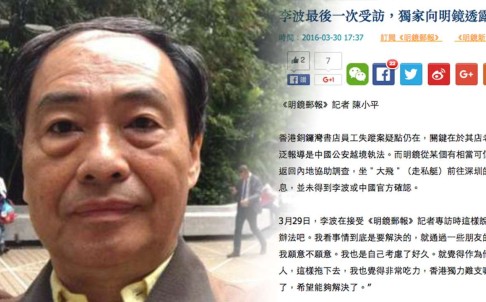
‘It was my duty’: Hong Kong bookseller Lee Po says he went to mainland China because his employees were in trouble

Despite sharing extensive account of trip with New York-based news outlet, man at centre of bookseller mystery refuses to shed light on how he left city

DANNY.LEE@SCMP.COM

UPDATED : Thursday, 31 March, 2016, 1:34pm

Lee Po did not specify what kind of trouble his employees were in, or which specific employees needed help. Photo: SCMP Pictures

The key player in Hong Kong’s bookseller mystery has given his longest and widest-ranging interview to date.

Despite his earlier pleas for privacy, Causeway Bay bookseller Lee Po has given a fresh account of his disappearance and the fate of his colleagues that raises more questions than answers.

In the telephone interview with New York Chinese-language media outlet Mingjing News, Lee was hesitant and evasive about key details of his return to mainland China despite being offered opportunities to clarify the situation and dispel fears that he was kidnapped.

The bookseller vanished from Hong Kong last December and later surfaced on the mainland, then returned to Hong Kong last week and told local authorities that he did not require any police or government assistance. The same requests were made by his two associates – Cheung Chi-ping and Lui Por – when they returned to the city earlier this month after disappearing last October.

Lee told Mingjing News he went back to the mainland illegally because three of his staff members were in trouble there. He did not say what kind of trouble, and was not specific on which employees needed assistance.

When he was on the mainland, Lee realised his associate Gui Minghai was also in trouble, and ended up helping with an investigation into the latter. Gui is a writer and co-owner of publishing house Mighty Current.

Lee said: “I was trying to solve my employees’ problems. [Because] the boss should be responsible for them ... but also because they hurt the company’s business. I felt it was my duty to help them out.”

When asked who assisted him in “sneaking” back to the mainland, Lee responded: “I was willing to go. Who accompanied me, I do not have to say. Whoever it involves, [naming them] impacts others. Sorry.”

I was willing to go. Who accompanied me, I do not have to say.

BOOKSELLER LEE PO

He subsequently claimed that “a friend” arranged his cross-border movements, but did not say if he made the journey by boat or car. He also did not explain why he did not cross the border legally using his home-return permit. There are no official records of him leaving the city.

Noting that before Lee went back to assist with the investigation, he had told an international media outlet that he could not return to the mainland, theMingjing reporter asked if he had been afraid.

Lee said he had been a little scared but, as the boss, and as the situation was “dragging on”, he went back hoping to be able to help solve the problem.

On the status of his fellow booksellers, Lee said bookstore manager Lam Wing-kee, one of three people mainland authorities had promised to release on bail, had not returned to Hong Kong because his family was on the mainland.

Lee told the media outlet that Cheung and Lui were out on bail but did not disclose more information because “they have the right to liberty”.

Gui, despite having been paraded on Chinese state TV, and Lam have not emerged publicly.

Lee also confirmed his decision to give up his British passport, but said that he had not started the process. He ruled out emigrating with his family, mentioning he had a son with autism, and said he wanted to live in Hong Kong.

Woo Chih-wai, who worked at Causeway Bay Books for two months before Lee disappeared, told the Post the “friend” mentioned in the interview was Chan Hin-shing, an investor in the struggling bookstore.

“It has to be Chan, who I think is responsible for Lee’s being taken away to the mainland,” said Woo, who worked directly under Chan’s management last November until Lee disappeared in late December.

Chan was last seen accompanying Lee to the mainland in a vehicle last Friday, less than 24 hours after the bookseller returned to Hong Kong for the first time since he went missing.

Meanwhile, ahead of a US-led nuclear security summit, a bipartisan US congressional committee on China has urged President Barack Obama to press his Chinese counterpart Xi Jinping on “the marked deterioration” in human rights and the rule of law since Xi became president.

The committee, including co-chair Marco Rubio, who recently suspended his US presidential campaign, expressed concern about the bookseller case and the arrest of foreign citizens, including US citizen Sandy Phan-Gillis.

The committee said these were issues that raised questions about China’s commitment to its promises to ensure “a high degree of autonomy” for Hong Kong and the safety of Americans doing business in China. It also urged Obama to present the Chinese president with a “priority prisoner list”.

http://m.scmp.com/news/hong-kong/law-crime/article/1932222/it-was-my-duty-hong-kong-bookseller-lee-po-says-he-went

Beijing says National Party threatens sovereignty - RTHK

rthk.hk - Express NewsToday, 02:06
  • The SAR government pointed out that advocating independence violates the Basic Law. RTHK file photo

    The SAR government pointed out that advocating independence violates the Basic Law. RTHK file photo

The Hong Kong and Macau Affairs Office says the SAR government has done the right thing by denying the company registration of the newly-founded Hong Kong National Party. The SAR government also warned that advocating independence is in breach of the Basic Law.

The party announced its establishment on Sunday, saying its agenda includes creating an independent Hong Kong republic and abolishing the Basic Law.

In an interview with Xinhua, a spokesman from the Hong Kong and Macau Affairs Office said "an extremely small number of people" have set up a pro-independence body, which endangers China's sovereignty and safety, as well as Hong Kong's prosperity, stability and fundamental interests.

He said the entire Chinese population, including everyone in Hong Kong, strongly opposes such acts.

Meanwhile, the Department of Justice said advocating independence is a breach of the Basic Law, and also goes against Hong Kong's status as a special administrative region. It said it will maintain close contact with law-enforcement agencies and take appropriate action if necessary.

http://news.rthk.hk/rthk/en/component/k2/1251713-20160331.htm

Expert urges easing of food truck import rules - RTHK

rthk.hk - Express NewsToday, 12:08
  • Simon Chung says cost of joining the food truck scheme will not be cheap. Photo: RTHK

    Simon Chung says cost of joining the food truck scheme will not be cheap. Photo: RTHK

The Hong Kong Food Truck Association said the government should consider allowing import of food trucks from the United States or Europe to reduce the financial challenge of joining new food van scheme.

Given the requirements and the huge cost of setting up each truck, experts believe it will cost around HK$600,000 to run a food truck. But Commerce Secretary on Wednesday played down the cost factor, saying the licencing will depend more in their cooking ability than financial clout.

But the chief executive of the truck association, Simon Chung, the estimated budget of around HK$600,000 is about right as a van that has to comply with all the government regulations like fire resistance, air flow and other safety measures will not be cheap. 

He said someone starting with a HK$300,000 loan will have to think carefully as they may able to buy a truck but not the kitchen equipment needed within that budget. 

Chung said government should consider allowing import of food trucks from the United States or Europe. But he said currently trucks that are left-hand drive are not allowed here. 

He said if this allowed, we can bring some used truck, remodel and refit this for use here. These trucks are beautiful and colourful and add charm to the scene, he added.

http://news.rthk.hk/rthk/en/component/k2/1251781-20160331.htm

Hong Kong Government Issues Warning to Independence Activists

Radio Free AsiaToday, 02:25

UPDATED at 4:30 P.M. EST on 2016-03-30

Three days after a new political party said it would campaign for independence for the former British colony, Hong Kong's government on Wednesday warned it would take action against "any suggestion" that the city should go it alone.

In an unprecedented statement given the semi-autonomous city's traditional freedoms of speech and association, the SpecialAdministrative Government issued a statement on its website warning against further discussion of the topic.

"The Hong Kong SAR is an inalienable part of the People's Republic of China," the statement said.

"Any suggestion that Hong Kong should be independent or any movement to advocate such 'independence' is against the Basic Law," it said, in a reference to the mini-constitution that has governed Hong Kong since the 1997 handover to China.

Such suggestions would "undermine the stability and prosperity of Hong Kong and impair the interest of the general public," it said, warning: "The SAR Government will take action according to the law."

Article 23 of the Basic Law requires the city to enact laws "to prohibit any act of treason, secession, sedition, subversion against the Central People's Government," but an attempt to bring in such legislation in 2002 sparked a massive demonstration on July 1, 2003,hastening the departure of then chief executive Tung Chee-hwa.

The warning, which appeared to mimic exactly the wording used by Chinese officials, comes after activists announced the formation of the Hong Kong National Party onSunday, setting out a pro-independence and anti-Basic Law agenda.

"The Hong Kong National Party will take part in any form of effective disobedience, including in the legislature, on the streets, and in the court of public opinion," the party's convenor Chan Ho-tin told reporters.

"We will also participate in labor strikes, as well as class and market boycotts," Chan said in video footage posted by governmentbroadcaster RTHK.

Legal basis of threat questioned

The party said in response to the government's warning on Wednesday that the Basic Law was "a draconian law" drafted without any input from the people of Hong Kong.

"Our party regards [the government's warning] as a legal absurdity," it said in a statement posted on its Facebook page.

"In no civilized society in the 21st century with a constitutional government do people get charged with crimes like separatism orincitement to overthrow the government."

"We will fight this draconian law all the way ... and campaign alongside the people of Hong Kong for independence," the statement said.

Chan had earlier said the party plans to field candidates in forthcoming elections to the city's Legislative Council (LegCo).

Democratic Party lawmaker James To said he knew of no legal basis for the government's apparent threat.

"There is no mention of Hong Kong independence in any of Hong Kong's laws, and merely talking about it comes under freedom of expression, which is protected under international covenants and in the Basic Law," To told RFA.

"However, it is a crime to use force or terrorism to coerce the government into doing something," he said.

The International Covenant on Civil and Political Rights, the International Covenant on Economic, Social and Cultural Rightsremained in force following the 1997 handover, after which the city was promised no change in its traditional freedoms for 50 years.

The Basic Law also guarantees the right to freedom of speech, freedom of the press and of publication; freedom of association, freedom of
assembly, freedom of procession, of demonstration, of communication, of movement, of conscience, of religious belief, and of marriage; and the right and freedom to form and join trade unions, and to strike.

China's official media slammed Chan's party, calling it a purveyor of "illegal" and "extreme" ideas.

"Extreme ideas are emerging in Hong Kong, but establishing a Hong Kong National Party is taking it too far," the Global Times newspaper, which is published by the ruling Chinese Communist Party, said in an editorial.

"Hong Kong independence is a fake proposition without any possibility of realization," it said, questioning whether advocacy of independence should be protected by the city's traditional freedom of speech.

It said "the consensus is that turning illegal ideas into action is not related to freedom of speech and therefore should result in legalconsequences," the paper said.

It called for steps to be taken "to prevent radicals from harming the normal functions of society."

Reported by Ho Shan for RFA's Cantonese Service. Translated and written in English by Luisetta Mudie.

http://www.rfa.org/english/news/china/china-hongkong-03302016135427.html

Mother of Uyghur who Disappeared in 2009 Faces Charges Over Interview

Radio Free AsiaToday, 04:59

The mother of a young Uyghur man believed to have been forcibly taken away after 2009 riots in Urumqi will go to court next month to face charges of leaking China state secrets for discussing her son’s disappearance in an interview with Radio Free Asia, a source close to the family said.

Widow Patigul Ghulam has been one of the most vocal Uyghurs who have been pressing authorities on the whereabouts of family members missing during the violence in Urumqi on July 5, 2009 between minority Muslim Uyghurs and Han Chinese that left 200 people dead.

Her son, Imammemet Eli, who would now be 32, was taken by police on July 14, 2009 and she last heard about him nine months later, when fellow inmates said he was found severely tortured and taken to a hospital.

Patigul Ghulam has been pressing local police in Urumqi, capital of the Xinjiang Uyghur Autonomous Region, for information on her son ever since, but has not received any satisfactory answers.

The son is among several thousand people, according to Uyghur exile groups, who were forcibly disappeared in the aftermath of the violence, the most deadly episode of ethnic unrest in China’s recent history.

Closed trial on April 7

Patigul Ghulam, who had been under house arrest and under heavy surveillance since September 2012, was detained in May 2014, a month after she gave an interview to RFA’s Uyghur Service. At the time, she said that she met with Wang Mengshen, the Urumqi city police chief, and said that Wang told her the police were still looking for her son.

Patigul Ghulam now faces a closed court session on April 7, a person close to her family told RFA. The source requested that her identity not be revealed for fear of retaliation from the government.

“The court convenes on the 7th of April.  None of her kids were given permission to attend. Right now they are waiting for the government’s reply to their request to attend to the court session,” the source told RFA.

After their mother was detained, her other three children were put under surveillance and faced interrogation. They recently were granted the right to visit their mother once a month, on the precondition that they not speak to any foreign media, the source added.

“Only one of them is working, in an invitation card publication shop. Their economic situation is not that good, either,” said the source.

A police officer at the Bahuliang police station in the Thenritagh (in Chinese, Tianshan) district of Urumqi declined to comment on the case when contacted by RFA.

“I do not have permission to speak on this case,” he said.

A neighborhood committee worker in Bahuliang, location of the family home, also declined comment.

“I do not know anything about her situation. There is special personal that is in charge of her case. You should ask him,” she said.

Reported by Gulchehra Hoja for RFA’s Uyghur Service. Translated by Mamatjan Juma. Written in English by Paul Eckert.

http://www.rfa.org/english/news/uyghur/uyghur-disappearance-03302016165414.html

Report on new government's diplomatic appointments denied

Latest | FOCUS TAIWAN - CNA ENGLISH NEWSToday, 11:32

Taipei, March 31 (CNA) Taiwan's Democratic Progressive Party (DPP) denied a newspaper report Thursday on the next government's diplomatic appointments that include former Vice President Annette Lu (呂秀蓮) and former Premier Su Tseng-chang (蘇貞昌).

The report on the front page of the pro-DPP Liberty Times is "not true," said party spokesman Ruan Jhao-syong (阮昭雄), who asked the media to refer to formal announcements in the future.

Lu, who the paper said is to become Taiwan's ambassador to Panama, also denied the report, saying that she has not considered such a move and will not consider seeking any job in the DPP government that will be sworn in May 20.

Su, who was reported by the newspaper to be tapped as the new government's representative to Singapore, said through his office that he has no knowledge of the personnel arrangement.

In addition to Lu and Su, former Foreign Minister James Huang (黃志芳) will go to Jakarta as Taiwan's envoy to Indonesia, according to the Liberty Times report, penned by the paper's Deputy editor-in-chief, Tzou Jiing-wen.

The paper also repeated earlier news reports that career diplomat Stanley Kao (高碩泰) will be Taiwan's next representative to the United States and that former Premier Frank Hsish (謝長廷) will be posted in Tokyo as Taiwan's envoy to Japan.

"This reporter has sought clarification from each of those named (in this article) and has learned that they have been consulted by President-elect Tsai Ing-wen (蔡英文) and have given a positive response," Tzou claimed in her report.

"The deployment of party elders in an effort to secure the development of Taiwan's external relations is seen as a skillful play in the (new government's) distribution of power," according to Tzou.

The appointments "also meet the needs of the new government's policies," she said.

The Liberty Times has published several articles on possible appointments by the incoming administration, including the naming of David Lee (李大維), a former representative to the U.S., as Taiwan's next foreign minister.

(By Lu Hsin-hui and Elizabeth Hsu)
ENDITEM/J

http://feedproxy.google.com/~r/rsscna/EngNews/~3/-CDEURXomAA/201603310006.aspx