Translate

May 26, 2018

Politico and SCMP jump into bed/have a quick grope

by biglychee / May 24, 2018
US media company Politico and the South China Morning Post announce a mildly surprising collaboration agreement.
The SCMP’s report perhaps sounds a little self-congratulatory, rather as Hong Kong officials do when receiving their idiotic annual World’s Freest Economy Prize from the Heritage Foundation. Without wishing to sound cruel – could it be that a Hong Kong newspaper owned by pro-Beijing interests is rather flattered to have the Washington Post/Time types at Politico treat it as an equal?
But maybe that’s what they want you to think: as recent trade talks show, the Chinese can get anything by letting the gullible Americans think they are winning.
Politico’s statement talks of expanding coverage to include China as if it were a new and exciting idea (the Washington-centric outfit’s previous venture overseas was four years ago in sleepy Brussels, as the EU’s slide into insignificance gathered pace). To add to the impression of innocents abroad, it creates a stir by describing its new Hong Kong partner as “the oldest newspaper in Asia [wrong] and … the only independent English-language publication in the region [hmm…]”.
The deal is focused on sharing content – cutting and pasting each other’s articles. This raises the question of whether Politico is aware of the possibility that some (in fairness, not all) SCMP China coverage might have a pro-Communist Party bias.
Jack Ma’s SCMP has a declared mission to ‘explain’ China to a global audience. Attentive readers will have noticed that the SCMP’s on-line articles now helpfully use English as well as metric measurements. And the paper is encouraging staff to write more items with international appeal. If Politico carries the right sort of SCMP stories, Jack succeeds in his patriotic soft-power-creating duties.
It’s hard to see what Politico gains. Does it want to scoop other US media in carrying staged interviews with Mainland political prisoners reading out forced confessions?
Alternatively, it could be that a flow of Politico content dilutes or displaces the SCMP’s China-cheerleading, West-bashing ‘positive energy’ material. Let’s be open-minded. (Indeed, the whole thing could be another evil foreign plot like Peppa Pig, to spread Western influence and bring down the CCP.)
Or it could be that the two simply see more mundane and basic reasons to cooperate.
The SCMP might hope to learn from Politico’s business model, which includes print, on-line, paid, free and regional products, including a subscription daily briefing pitched at ‘insiders’. It achieves the rare feat of at least sometimes making a profit from political journalism in the digital age.
And they are talking about staff exchanges. Like many in the Beltway comfort zone and similar Western media habitats, the expert elite Arlingtrons at Politico would surely benefit from some exotic global mind-broadening Asian exposure.
The least-exciting explanation is often the best.

http://biglychee.com/?p=19702

May 18, 2018

Asia’s mumbling-inanities and hand-wringing hub

For the second time in a week, security men assault Hong Kong reporterscovering sensitive stories on the Mainland. Outraged citizens imagine that the Hong Kong government will take a stand – but they should be thankful for a bit of pro-forma hand-wringing.
It’s like expecting Hong Kong leaders to indicate whether candidates calling for an end to one-party dictatorship in China will be barred from the ballot. Their response is essentially: don’t ask me, I’m only in charge of the office paper clips. In the background, behind a half-closed door, a Beijing official rants that China is not a one-party dictatorship and calling for an end to this non-existent regime is forbidden.
If you were representing Hong Kong’s puppet/doormat administration awaiting instructions, you would mumble inanities too.
The UK’s Benedict Rogers, chair of Hong Kong Watch, summarizes the ‘lawfare’ Beijing (in the guise of the Hong Kong authorities) is using against the city’s pro-democrat activists. It is a damning synopsis. The government, he notes, has prosecuted one in three pro-dem legislators since Occupy, often using desperate and archaic charges.
Unfortunately, Rogers’ proposed remedies are also unconvincing and stale (presumably influenced by our traditional mainstream pro-democrats).
He says the public prosecutions function should be transferred from the Beijing-approved Secretary for Justice to independent hands. This directly contradicts the Communist Party’s view of ‘seamless’ government – the reason police, electoral and other departments have lost their (relatively) impartial public-service character in the last four years and become political tools. He also hopes, or dreams, the international community will do something.
If it’s any consolation, Chief Executive Carrie Lam and her colleagues, grasping for something coherent to say while Beijing freaks out, can sympathize with such helplessness.

http://biglychee.com/?p=19671

May 17, 2018

Lawfare Waged by the Hong Kong Government Is Crushing the Hopes of Democrats

May 15, 2018
Lawfare Waged by the Hong Kong Government Is Crushing the Hopes of Democrats
Image Credit: Flickr / studiokanu
Law is being used to silence the democracy movement in Hong Kong.
One in three pro-democracy legislators has been prosecuted by the government since the Umbrella Movement of 2014. More than 100 democracy activists and protestors have been prosecuted. The secretary of justice has constantly sought to maximize sentencing, slapping years of jail time on young students and digging up obscure, outdated charges – designed for 19th century Britain, not 21st  century Hong Kong – to increase the time that pro-democracy figures spend in jail.
Hong Kong’s political system is rigged in favor of the establishment. A committee of 1,200 people made up of tycoons, property developers, and other elites chooses the chief executive. Forty percent of the seats in the Legislative Council are decided by functional constituencies, elected not by the general population but by businesses and professions, which consistently vote to maintain the status quo. Despite the democrats representing 60 percent of the popular vote, they have no way of holding the secretary of justice, who oversees prosecutions, to account.
As a result, the law is being used to intimidate opponents, disqualify lawmakers, and limit freedom of expression. Legal commentator Antony Dapiran has called the strategy “lawfare” – the use of law as a tool in the political battle to create conformity.
The conviction of Baggio Leung and Yau Wai-Ching, two localists elected as legislators in 2016, on charges of “illegal assembly,” is just the latest example of lawfare against democrats. Accused of attempting to barge their way into a meeting after they were barred from entering to retake their oaths as lawmakers, they could be jailed for up to three years for gathering in the legislature to which they had been elected. Their failure to take their oath in the correct manner the first time would, in most normal democratic legislatures, have been addressed through an internal disciplinary mechanism – a temporary suspension from the chamber, perhaps, followed by a chance to retake their oath “properly.” Indeed, that is what Hong Kong’s legislature offered and past precedent provided for, but Beijing reinterpreted the Basic Law, effectively amending the legislation, and turned it over to the courts. Instead of being given the second chance they should have had, they were disqualified from the legislature, denied the right to retake their oath or appeal, and convicted of a criminal offence that could land them in jail. The mix of farce, absurdity, and cruelty is astonishing.
A few days previously, democratic legislator Ted Hui Chi-fung was released by the police on bail, facing potential prosecution on four charges including criminal assault, dishonest access to a computer, obstructing a public officer, and criminal damage. His actions were undoubtedly absurdly foolish – he took it upon himself to snatch a mobile phone from a civil servant in the legislature, claiming she was monitoring the whereabouts of lawmakers in order to marshal their support for a government bill. He disappeared into the men’s toilet for a few minutes with her phone. In any other legislature, Hui would be subject to some disciplinary sanction for such a stupid act – perhaps suspension for a day or two – but the disproportionate criminal charges take an already farcical case to even greater heights of absurdity.
Outside the Legislative Council chamber, the crackdown on protestors and democracy activists has been even more intense. The founders of the Occupy Central protests in 2014, Benny Tai and Chan Kin-man, are being charged with “public nuisance,” “incitement to public nuisance,” and “incitement to incite public nuisance.” Public nuisance charges in common law jurisdictions are designed typically for young delinquents who kick over bins and are supposed to be accompanied by a punishment of community service. Benny Tai and his colleagues are facing up to seven years in jail as the secretary of justice has concocted a cocktail of charges designed to maximize the punishment against peaceful protest for democratic reform.
And, separately, more than 100, predominantly young, people have been charged under the Public Order Ordinance. These charges are clearly politicized, as is evidenced by the fact that members of the establishment do not receive the same treatment. Police violence during protests was excessive, yet in the majority of cases has gone unpunished or investigated. Junius Ho called for those who advocate Hong Kong independence to be “killed mercilessly,” yet he has not been prosecuted – due to “lack of evidence.” Where has the principle of everyone equal before the law gone?
It is worth noting that the problem lies with the choice of prosecution and the abuse of law by the state, not the independence of the judiciary. By and large, judges’ integrity is still intact. But the rule of law is increasingly threatened by its unequal application.
So what is the way forward?
First, in order to protect the rule of law in Hong Kong, the secretary of justice, who is a political appointee, should no longer be in charge of prosecutions. In Britain, for example, prosecutions come under the director of public prosecutions and the Crown Prosecution Service – the secretary of justice shapes the policy, not the prosecutions.
Second, it is time for the international community, and the United Kingdom in particular, to press China to allow the genuine universal suffrage, which the people of Hong Kong were promised under the Sino-British Joint Declaration, to protect the rights guaranteed under the Basic Law, and to ensure proper checks and balances are in place for the executive, legislative, and judicial system.
Third, democrats of all shades in Hong Kong need to reflect on their own conduct and exercise both greater unity and maturity. Swearing at China in an oath-taking ceremony or stealing an official’s mobile phone are not sensible acts conducive to advancing democracy. They are foolish and counterproductive. Nevertheless, they are moments of stupidity not criminality, and are born out of the depths of frustration to which Beijing’s broken promises and the Hong Kong government’s failure to stand up for Hong Kong have driven them. They deserve a sympathetic frown and a friendly raised eyebrow, not a prison sentence and a criminal record.
Lastly, while some individuals have acted unwisely, Hong Kong’s democrats include many deeply impressive, inspiring people, of all generations and persuasions, who deserve the admiration and support of the world. For the younger generation in particular, they deserve respect – they do not deserve, by any measure, to spend their formative years behind bars. It is time to get behind Hong Kong’s democrats, and put an end to Beijing’s “lawfare.”
Benedict Rogers is founder and Chair of Hong Kong Watch, and East Asia Team Leader at Christian Solidarity Worldwide.

May 01, 2018

Lord Ashdown: Windrush highlights how the UK has failed Commonwealth citizens in her last colony - Hong Kong

Former Liberal Democrat leader Lord Ashdown compares the Windrush scandal to how the citizens of Hong Kong were treated twenty one years ago when the last British colony was handed over to 'a burgeoning post-communist China'.
Lord Ashdown
Credit: 
PA
Britain’s continued failure to her former colonial subjects, as exemplified by the Windrush scandal, is a national embarrassment. The last couple of weeks demonstrate that institutionalised racism, stimulated by Government policy – especially targets -, is alive and kicking within government departments, and has, with the almost certain knowledge of Ministers, been there for decades. Its consequence is that those from the Commonwealth have been treated as second class citizens and not as equals.
 
The scandal initially focussed on the Windrush generation in the Caribbean, but it is increasingly clear that Britain has failed in its duty of care to Commonwealth citizens across the globe. Numerous cases involving non-Caribbean Commonwealth-born citizens from Kenya to Canada have now come into the open.
 
We are urgently in need of some soul-searching enquiry about our neglect of duty towards our former colonial subjects. This should not only focus on the cases of sudden deportation or denial of rights which are now coming to light, but should also consider the rights of other minorities such as British Nationals (Overseas) in Hong Kong.  
 
Twenty one years ago Britain handed over her last colony, Hong Kong, to a burgeoning post-communist China. Although under British sovereignty for a century, the British and China decided that Hong Kongers would not be part of the Commonwealth or be given the right to self-determination, and therefore after 1997 Hong Kongers were given no special status in the eyes of the United Kingdom.
 
At that point, there were about 3 million British Dependent Territories Citizen (BDTC) passport holders (including people born before July 1, 1997 in Hong Kong, and naturalised British subjects) with right of abode in the UK. But against their wishes, Hong Kongers were stripped of their right of abode and many of the core rights which they desired and deserved, and given the option to apply for ‘British National (Overseas) Passports’ or the ‘BNO’ with their rights limited to holiday travel and the right to vote.
 
At the time, the Tiananmen Square massacre of 1989 was recent memory and many in Hong Kong felt their British citizenship was a vital lifeline in case China were not sincere in their handover commitment to give Hong Kong a ‘high degree of autonomy’ and uphold their ‘rights and freedoms’. I campaigned for Hong Kongers to be given the right to claim British citizenship as a last resort if China failed to live up to the promises enshrined in the international treaty to which Britain laid its hand. But the then Conservative government refused to consider this. The BNO, sarcastically referred to by Hong Kongers as ‘Britain says no’, was viewed as a betrayal as the UK just cancelled the citizenship of her former colonial subjects.
 
In the immediate aftermath of the handover, those who thought this move was justified felt vindicated as Hong Kong’s autonomy was respected and ‘one-country, two-systems’ functioned well. But in recent years things have taken an ominous turn for the worse.
 
In November, I visited Hong Kong and met with people from across the political spectrum. They shared that over the past five years, the freedoms guaranteed to the people of Hong Kong in its mini-constitution, the Basic Law, have been increasingly eroded. Booksellers have been abducted, press freedom is under pressure and many political activists are being jailed. Judges are complaining that rule of law, although intact, is creaking as the objectivity of the Department for Justice is in doubt and the city appears no closer to democracy.
 
While on that trip, Emily Lau, the previous leader of Hong Kong’s Democratic Party, asked me if Britain would throw a lifeline to Hong Kong and give them the right of abode, “so that they can feel they have a home to go to, if things go desperately wrong here.”
 
Just as we failed those who travelled to the UK on the Windrush, we have also failed Hong Kong during the handover negotiations by stripping British citizens of their citizenship. The Windrush saga highlights that we have consistently neglected our former colonial subjects who have been used, abused, betrayed and disregarded. Britain’s honour has been dragged in the dirt over Windrush. We must not allow this to happen again over the British Nationals we left behind in Hong Kong.   
 
Lord Ashdown of Norton Sub-Hamdon is the former leader of the Liberal Democrats and a patron of Hong Kong Watch

Posted On: 
30th April 2018

https://www.politicshome.com/news/world/china/opinion/house-lords/94782/lord-ashdown-windrush-highlights-how-uk-has-failed

April 21, 2018

How China stripped Hong Kong of its right to self-determination in 1972 – and distorted history

By Joshua Wong and Jeffrey Ngo, originally published in Chinese on The Initium in 2016. Translated by Jeffrey Ngo.
44 years ago last week, the United Nations General Assembly adopted Resolution 2908 by a 99:5 vote. Among its effects were the removal of Hong Kong and Macau from the U.N. list of Non-Self-Governing Territories. Consequently, the peoples of Hong Kong and Macau – as colonised peoples – lost their right to self-determination granted by the U.N.’s 1960 “Declaration on the Granting of Independence to Colonial Countries and Peoples.”
united nations
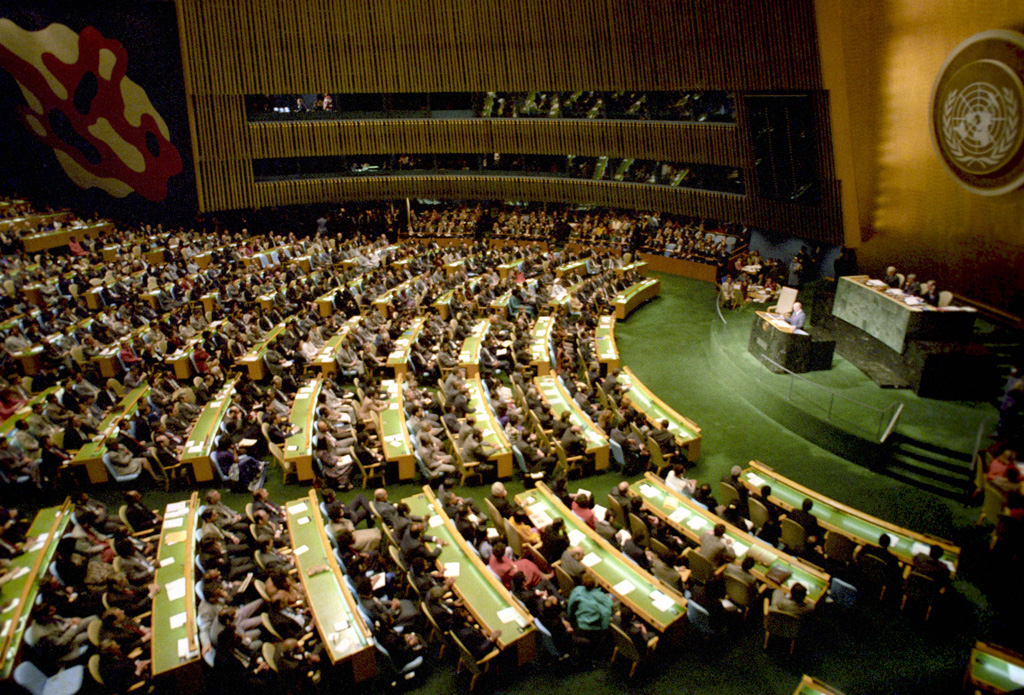
A United Nations session. File Photo: Wikicommons.
In an op-ed in Ming Pao last month, the Chinese Foreign Affairs Ministry in Hong Kong interpreted this episode as 99 U.N. member states agreeing that “Hong Kong did not fall within the ambit of colonisation.” U.N. documents from 1972 associated with this resolution, however, indicate that this view is extremely misleading.
So what actually happened?
China’s demand
Less than four months after the People’s Republic of China formally became a U.N. member state in November 1971, Huang Hua, its ambassador to the U.N., rushed to issue a letter (File A/AC.109/396) to the Special Committee on Decolonisation that expressed strong opposition to the U.N.’s classification of Hong Kong and Macau as colonies.
Hong Kong and Macau were instead “part of Chinese territory occupied by the British and Portuguese authorities,” Huang declared unilaterally. “The settlement of the questions of Hong Kong and Macau is entirely within China’s sovereign right… The United Nations has no right to discuss these questions.”
In response, the chairman of the committee assented to China’s demand by giving recommendations to the General Assembly through the committee’s annual report of 1972 based exactly on Huang’s letter.
Official records
Yet this committee report of 1972 (File A/8723/Rev.1) had five volumes totalling 1,198 pages, of which only paragraph 183 in page 64 of volume I mentioned the question of Hong Kong and Macau – this is undoubtedly a very trivial part of the entire document. Moreover, because periodical reports of this nature intended only to record and cover the work of each committee, they usually received negligible attention from the General Assembly, which seldom had any reason to veto them.
china united nations huang hua
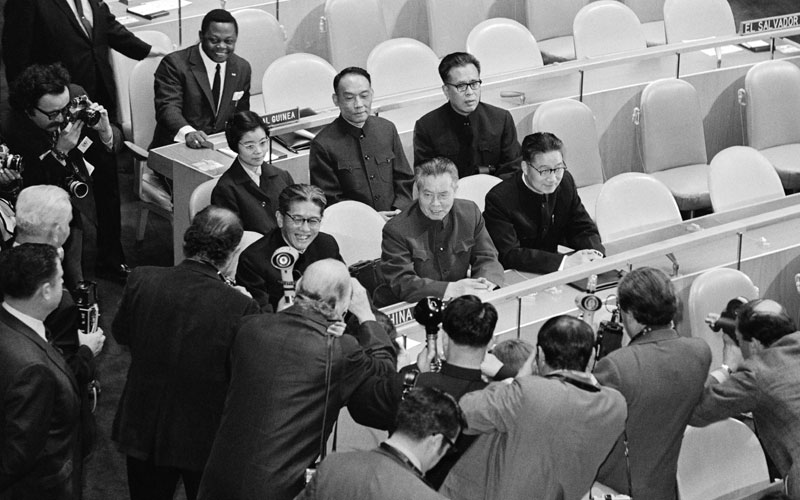
PRC delegate seated in the UN in 1971, including Permanent Representative to UN Huang Hua (centre). File Photo: UN.
More importantly, the General Assembly had just been drafting a resolution on decolonisation at the time the report was submitted. Upon acknowledging the committee’s work in section 2 of the resolution, passing its annual report as a procedural convention was included in section 3, which altogether was subject to a single vote.
This resolution, numbered 2908 and entitled the “Implementation of the Declaration on the Granting of Independence to Colonial Countries and Peoples” (File A/RES/2908(XXVII)), happens to be the one mentioned in the beginning of this article. As its name suggests, the 18-section resolution aimed to support the U.N. in further accelerating global decolonisation. Section 5 condemned colonialism, for example, while section 6 reaffirmed the U.N.’s “recognition of the legitimacy of the struggle of the colonial peoples and peoples under alien domination to exercise their right to self-determination and independence by all the necessary means at their disposal.”
Historical mistake
It is manifest, based on verbatim records of the plenary meetings in which the resolution was discussed, that most – if not all – representatives of member states who voted for the resolution did so because they wished to see without delay the liberation of colonised peoples; it was not a vote on Huang’s demand.
china-hong-kong-flag
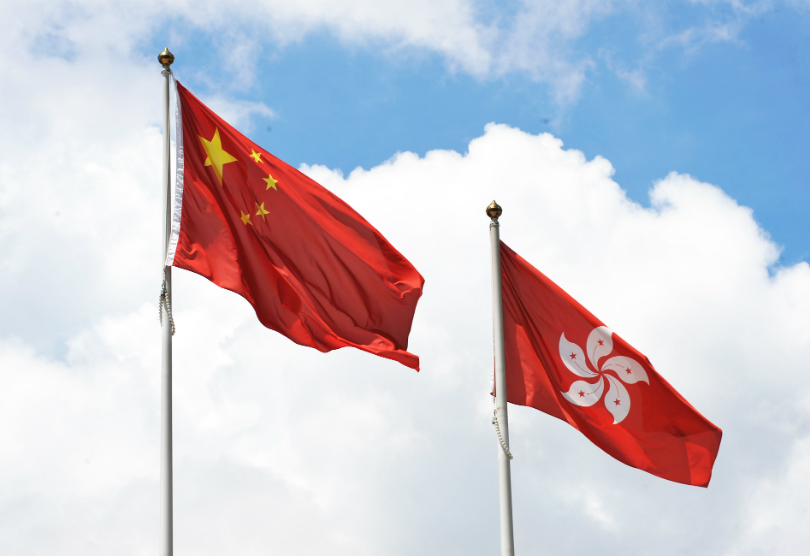
Photo: GovHK.
There are good reasons, in addition, to doubt whether these representatives were even aware of such controversy at the time they cast their vote: first, the question of Hong Kong and Macau was tremendously obscure in the report, which contained over a thousand pages; second, the report itself was not the main point of the resolution.
Precisely because whether Hong Kong and Macau should be removed from the U.N. list of Non-Self-Governing Territories had not been brought up as the basis of a separate resolution, the General Assembly never adequately debated and voted on it, ultimately leading to the historical mistake in 1972.
Flagrant distortion of history
That Hong Kong and Macau continued to be British and Portuguese colonies, respectively, for the next 25 and 27 years is an indisputable reality with wide international consensus. This fact is unrecognised only by China and the U.N., whereas Britain and Portugal as suzerain powers do not dare to dispute it. As a result, the people of Hong Kong and Macau had lost a voice in their own future.
Either way, it is a flagrant distortion of historical facts for China today to imply deliberately that 99 member states were opposed to the peoples of Hong Kong and Macau exercising their right to self-determination on November 2, 1972, when in fact those 99 member states had basically voted for the exact opposite – in support of Non-Self-Governing Peoples to exercise their right to self-determination.
Understanding this episode is pivotal to understanding the ongoing self-determination movement in Hong Kong.
Joshua Wong is the Secretary-General of the Demosistō party. Jeffrey Ngo is a master’s student of Global Histories at New York University.
https://www.hongkongfp.com/2016/11/08/china-stripped-hong-kong-right-self-determination-1972-distorted-history/

April 20, 2018

Revenge of the Panda-huggers

by biglychee / Today, 12:24

Another week, another flicker of the needle on the Sense-of-Impending-Doom-ometer as the world plods inexorably towards Cold War II.
We detect something of a backlash on the part of the West’s rational, mature, cool-headed sophisticates who appreciate the Middle Kingdom’s unique history and psychology and Xi Dada’s vision in ways mere mortals do not. In various degrees of Panda-hugging-ness, they urge calm, constructive engagement and win-win cooperation. The South China Morning Postcarries the thoughts of a UK academic and Confucius Institute chair, who says ‘we must ensure we understand the fears and hopes of this rising empire’. Could Neville Chamberlain have put it better? A US observer bemoans the ‘determined effort to depict [China] as an unmitigated threat’.
Meanwhile, the unmitigated threat seems determined to continue depicting itself. The Chinese Communist Party is setting up student ‘cells’ in West Virginia, among other places. (Thanks to family connections, I actually know this misunderstood state, popularly imagined to be inhabited by inbred banjo-players, but in fact less exotic and mysterious, and in fact rather basic. The CCP is clearly overdoing itself – which is of course the whole point.)
The US government agencies responsible for taking action against ZTE display a sense of humour in a presentation offering lessons in how to avoid punishment, drawing on the Chinese company’s illicit business with Iran and North Korea. The US Treasury is looking at Chinese investments. European diplomats in Beijing are ‘unusually biting’ in their criticism of the Silk (as in Belt and) Road. I declare the weekend open with the thought of an even bigger potential can of worms being opened: the US is also thinking of imposing Magnitsky Act sanctions against Chinese officials involved in human rights abuses in Xinjiang.

http://biglychee.com/?p=19513

Report: EU countries to be straitjacketed by China's New Silk Road

European firms could miss out on China's $900 billion infrastructure initiative, warns a leaked report by EU diplomats. It said the New Silk Road trade corridor has the potential to disadvantage and even divide the bloc.
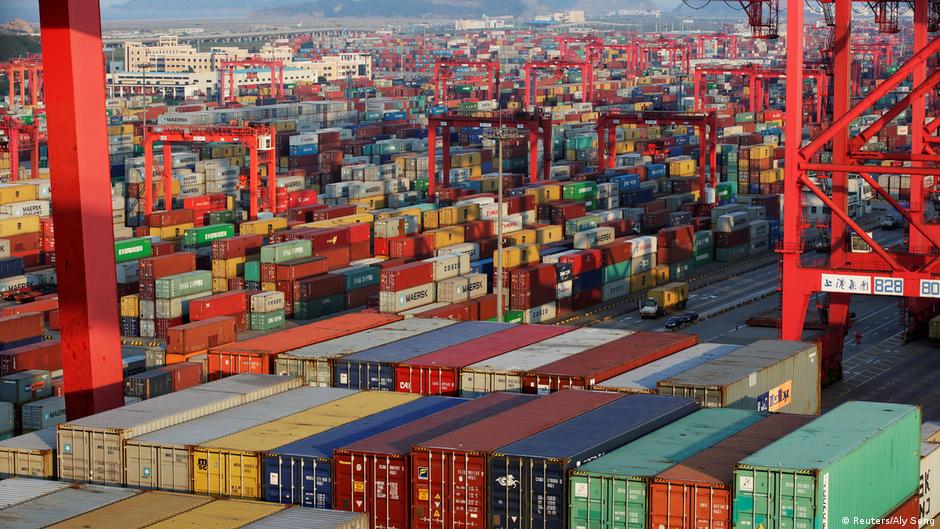
China container port in Shanghai (Reuters/Aly Song)
China's plans to create three huge trade corridors between Asia and Europe will likely hurt the European Union's trade interests, EU ambassadors have warned.
In a report leaked to German business daily Handelsblatt,  the diplomats cautioned that the $900 billion (€727 billion) mega infrastructure project "runs counter to the EU agenda for liberalizing trade, and pushes the balance of power in favor of subsidized Chinese companies."
Handelsblatt on Monday said the report contained "unusually biting content," as diplomats detailed their frustration at the lack of opportunities for European firms from the New Silk Road initiative, named after China's ancient trade route.
Report excludes Hungary
The paper was signed by the Beijing ambassadors of 27 of the 28 EU member states — with Hungary being the only exception.
We're sorry, but this video is currently not supported for AMP. To watch this video, please go to our mobile page.
New Silk Road — which is also known as the Belt and Road Initiative (BRI) — will enable China to oversee the construction of new roads, ports and pipelines that will run through 65 countries. The initiative is widely seen as helping to cement Beijing's position as a new global superpower.
China has promised the project will benefit all countries along its route, thanks to the greater connectivity it will allow. But its main trading partners are growing increasingly suspicious over Beijing's strategic objectives, amid concerns that Chinese state-owned firms are set to reap most of the benefits.
"(At present) ​European companies have to compete against their Chinese counterparts, who enjoy almost unlimited credit from Chinese state banks," Thomas Eder, a research associate at the Mercator Institute for China Studies in Berlin, told DW.
He said, even before plans for the New Silk Road have been finalized, the EU has already witnessed a decline in its share of trade with several developing countries because of large-scale Chinese investment in Asia and Africa.
Backing up the leaked report's findings, Eder predicted that unless there is a major push for China to boost transparency in the procurement process, European access to the BRI would be "only marginal."
He said Beijing has never hidden its ambition for the New Silk Road initiative to expand the presence and profits of Chinese firms abroad, who are encouraged to buy Chinese components and raw materials where possible.
Market access restricted
EU leaders and business executives have longstanding complaints about China's unwillingness to fully open its markets to foreign players. Despite Chinese assurances that reforms will be forthcoming, foreign firms insist they remain at a huge disadvantage when doing business in China or bidding for Chinese funded projects.
Reaffirming the EU's frustration, the leaked ambassadors' report urged EU states to remain united as they pressure Beijing to open up the bidding for key infrastructure projects.
"We shouldn't refuse to cooperate, but we should politely yet firmly state our terms," Handelsblatt cited one high-ranking EU diplomat as saying.
Damien Tobin, a lecturer in Chinese Business and Management at London's School of Oriental and African Studies (SOAS), believes the EU — which sits at the opposite end of the three trade corridors that make up the New Silk Road — will still benefit hugely from its completion.
He said many of the bloc's biggest companies are also well represented in countries along the trade route, and that Beijing has always been "clear on the areas where it sees benefits from the participation of foreign firms."
'Opportunities exist'
"Chinese companies have developed capabilities in areas such as infrastructure construction, but EU companies retain significant advantages in downstream technologies and financing," Tobin told DW.
We're sorry, but this video is currently not supported for AMP. To watch this video, please go to our mobile page.
Reacting to the leaked report, the European Union Chamber of Commerce in China said in a statement it was vital that trade and investment flow equally in both directions, and again called on Beijing to unlock its markets to foreign players.
"The success of the Belt and Road Initiative will largely be predicated on open markets, balanced trade, transparency and reciprocity," it wrote in an email to DW.
"The European Chamber expects to see transparent public procurement processes put in place that will allow European and Chinese companies, and especially private companies, to compete on an even playing field with projects going to the strongest bidders."
"Not doing so would likely result in funds being wasted and projects fail," the statement said.
European unity at risk
Another concern raised in the ambassadors' report was the potential of the New Silk Road initiative to sow division among the EU's 28 member states, many of whom are desperate to attract new Chinese investment to upgrade their crumbling infrastructure.
"China has already succeeded on several occasions in undermining EU cohesion," warned the Mercator Institute's Eder.
He said Hungary's refusal to sign the report was indicative of the benefits it is likely to receive from China's investment in Eastern Europe, which will see railways, motorways and power plants upgraded.
He also cited Hungary and Greece's refusal to sign EU statements critical of China's human rights record, and following the tribunal ruling on the South China Sea dispute.
China is already facing criticism for saddling partner countries in the New Silk Road project with too much debt. Sri Lanka, for example, was forced to offer a 99-year lease on the strategically located and bustling Hambantota Port to pay down debt.
But SOAS' Tobin believes it is not in China's long-term interests or those of its large state-owned enterprises to see the EU's fragile consensus torn apart.
"It is not clear that such (Chinese) investments would benefit from the uncertainty brought about by different rules on investment across different (EU) member states," he said.
Clarity needed
Instead of taking aim solely on Beijing, member states would profit from a more unified position on Chinese inward investment, Tobin suggested.
"(It) would prevent large quantities of perhaps inefficient and speculative investments concentrating in particular regions."
The EU's External Action Service, which is in charge of foreign affairs for the bloc, refused to comment on the leaked report.
But in an email to DW, it reiterated the European Council's support for the infrastructure initiative "on the basis of China fulfilling its declared aim of making it an open platform which adheres to market rules, EU and international requirements and standards, and complements EU policies and projects, in order to deliver benefits for all parties concerned and in all the countries along the planned routes."

http://amp.dw.com/en/report-eu-countries-to-be-straitjacketed-by-chinas-new-silk-road/a-43437084?tw=&__twitter_impression=true

February 22, 2018

Still room for at least 40 million more

by biglychee / Yesterday, 11:26

Hong Kong’s officials forecast tourist numbers will rise to over 60 million this year. Yet they whine that visitors are staying for ever-shorter periods. And publicly-subsidized Disneyland makes a loss yet again(HK$345 million – peanuts compared with the billions in land value and opportunity costs the white-elephant Mouse has swallowed).

It seems the more tourists we cram into Hong Kong, the more trouble the industry is in. And that makes perfect sense: tourism is undermining itself.

The obsession with tourist numbers arose from an obsession with Mainlanders-as-buyers-of-luxury-crap hoovering up Euro-trash brands and enriching the city’s landlords. As Mainlanders move on to more sophisticated vacationing, visitors are on average staying for less time and spending less – but all the tourism sector can think up is increasing throughput or adding increasingly desperate ‘attractions’.

Meanwhile, Hongkongers with sense, taste and a few days to spare head off to Taiwan or Japan. They are mostly not going for phony, culturally alien theme parks or tourist magnets (though some exist). They are not going to buy overpriced junk. Many are not even drawn specifically by scenic countryside or historic sites (though both countries have them). They go because they are nice places.

The transport is great. The food is great. The environment is clean, quiet, safe and pleasant – genuine communities with relaxed people enjoying a high quality of life in accordance with their own standards and customs. They are nice to live in, and as a result they are nice to visit.

All Hong Kong’s greedy, parasitical tourism industry and frenzied bureaucrats know is pushing up landlords’ rents and developers’ profits. And that means eradicating street markets and street food, and local stores, and replacing them with malls, malls and more sterile malls.

Having swamped Central and Sheung Wan with Koreans promised a fake ‘Old Town’ experience, officials are now set on wrecking poor Shamshuipo. After replacing the old hardware stores and groceries with international ice-cream, cake, perfumed-candle and other chains, the slash-and-burn tourism industry will move on to pulverize and ethnically cleanse another neighbourhood into a concept-theme-zone-hub.

Obviously, the ‘tourism’ lobby couldn’t care less that they are wrecking Hong Kong as a place for the city’s own (irrelevant) people to live in. But they’re so dumb, they’re wrecking it as a place worth visiting, and ultimately being a landlord in. The only silver lining: the selfie-snapping guidebook-obeying North Asian zombies will probably finally go away.

http://biglychee.com/?p=19220

February 21, 2018

Academics Protest China’s Censorship Requests

Scholars have formed a peer-review boycott to encourage journals to take a firm stance against requests to cull sensitive articles. By Shawna Williams | February 20, 2018 More than 1,000 people from around the world have signed a petition calling on major journal publishers not to censor their offerings within China in response to governmental pressure. The petition pledges a peer-review boycott, stating, “we will not agree to provide peer review service until editors confirm that their publications do not censor content in the [People’s Republic of China], and we call on all others to do so as well.” The petition, launched in October 2017, followed news last summer that some publishers and databases based outside China had received requests from Chinese importers of their print and digital content to block online access to certain academic articles within the country, says the petition’s creator, Charlene Makley, an anthropologist at Reed College in Portland, Oregon. Cambridge University Press revealed in August that it had been ordered by its Chinese importer to block access to hundreds of articles in its The China Quarterly journal within the country; it reversed course following an outcry from academics. In October, the Financial Times reported that some articles in Springer Nature’s journals cannot be found within China, including many with terms such as “Tiananmen,” “Taiwan,” and “Tibet.” Read “Springer Nature Blocks Access to Sensitive Articles Within China” The Cambridge University Press revelation “was kind of a watershed event in my mind . . . it brought to my attention that the reach of China had extended beyond its own borders,” Makley says. “I contacted some colleagues informally to talk about what they thought folks should do, and to me peer review is the very foundation of academic publishing . . . If we start there, then that is one way that individual scholars can have some leverage.” The idea is not so much to force change by making it hard for journals to find willing peer reviewers, but more to prompt awareness of and conversations about the issue among journal editors. Makley says some editors may not be aware of their companies’ practices, and she hopes her initiative will prompt managing editors and publishers to establish a position on censorship if they haven’t already. Before she agrees to a request to peer review a manuscript, Makley now asks the journal editor whether the journal or its owner censors content in China, and “in multiple cases they’ve come back with strong statements saying that they don’t censor,” she says. James Millward, a historian at Georgetown University and supporter of the petition, also sees withholding peer review as a particularly fitting way to respond to censorship. “It’s not perfect, but [peer review] is the system that we have evolved over centuries, and that is what makes academic speech different,” he says. Given that journals are curated by peer review, for an outside entity “just to come in and pick and choose [which articles to make available] is actually to violate this process at a very fundamental level,” he says. Our Chinese colleagues in China are at risk of not having full access to all research that’s available. —Charlene Makley, Reed College A spokesperson for Sage, which publishes more than 1,000 journals in the natural sciences and other fields, writes in an email that, “We have not received a request from the Chinese authorities or other entities to remove or block access to certain documents or content within China. . . . As a matter of general principle, SAGE Publishing does not block or remove content in response to such a request.” In response to a request for comment, Elsevier spokesperson Tom Reller responded in part, “Elsevier believes in the freedom to publish and read scholarly content anywhere across the globe.” But Reller did not say whether the publisher had received requests to censor comment, nor how it would respond. The UK-based publisher Taylor & Francis declined to comment, and Wiley (whose more than 2,000 journals include the Chinese Journal of Chemistry, published in cooperation with the government-affiliated Chinese Academy of Sciences) did not respond to requests for comment. Springer Nature defended its move to make some content unavailable in China, stating in an email to The Scientist, “we are required to take account of the local rules and regulations in the countries in which we distribute our published content. . . . This action is deeply regrettable but has been taken to prevent a much greater impact on our customers and authors. . . . We do not believe that it is in the interests of our authors, customers, or the wider scientific and academic community, or to the advancement of research for us to be banned from distributing our content in China.” Springer has offices in Beijing and Shanghai and publishes more than 100 journals in partnership with Chinese academic societies and institutions, according to its website. For Millward, who specializes in China and Central Asia, Springer’s argument doesn’t hold water. “They publish Nature, they publish Scientific American, they publish among the most important scientific journals. China is not going to block access for its scholars from all of those journals,” he contends. That said, access to many other major sites, ranging from Google to Facebook to The New York Times, has been blocked by China’s “Great Firewall.” For residents willing to go to the trouble, virtual private networks (VPNs) have long been used to circumvent these restrictions, but the government has recently cracked down on those too, according to The Guardian and other outlets. As of the deadline for this article, China’s Foreign Ministry had not responded to a request for comment. Makley says it’s important that academic publishers not accede to governmental pressure. “This is not just about China or China-related research,” but about the expansion of state power, she says. “Our Chinese colleagues in China are at risk of not having full access to all research that’s available.” https://www.the-scientist.com/?articles.amp/articleNo/51854/title/Academics-Protest-China-s-Censorship-Requests/&utm_content=buffere5848&utm_medium=social&utm_source=twitter.com&utm_campaign=buffer/rd/yes/&articles.view%2FarticleNo%2F51854%2Ftitle%2FAcademics-Protest-China-s-Censorship-Requests%2F=&__twitter_impression=true

The Backlash to Belt and Road

February 16, 2018 A South Asian Battle Over Chinese Economic Power By Andrew Small When Beijing announced its One Belt, One Road initiative five years ago, the global reaction was immediate and pronounced. OBOR, as it became known, was hailed as a transformative effort to deploy China’s economic might in service of its strategic goals. By going out of their way to reject analogies to the United States’ Marshall Plan in Europe, Chinese leaders in fact invited the comparison. Chinese ports, pipelines, roads, and railways would expand commercial, investment, and infrastructure linkages from Asia to Europe. They would build new markets, integrate poorly connected regions, and stabilize the Chinese periphery. Ultimately, they would lay the groundwork for a Sinocentric global order. No region seemed to make a more promising target for such ambitions than South Asia. Sparsely populated Central Asia is a transit route and energy source rather than a serious market. East Asian trade and infrastructure connections are already well developed. EU public procurement rules preclude a privileged role for Chinese companies. Russia is in economic decline. South Asia, by contrast, appeared to have all the right ingredients for the Chinese economic model: large populations, fast-growing economies, GDP per capita comparable to China’s a decade earlier, weak connectivity, and major infrastructure deficiencies. When Chinese Premier Li Keqiang undertook his first overseas visit in 2013, South Asia was the location he picked to tout two new economic corridors, a version of OBOR avant la lettre. But five years on, such hopes have proved unfounded. The region has instead become the main battleground for OBOR’s future—with India as its chief opponent, Pakistan as its chief enthusiast, and, in between, countries from Nepal to the Maldives facing economic choices that have become highly politicized. While the hope may have been that Chinese investment schemes would help mitigate competition in the region, the result so far has been precisely the opposite: OBOR has fused with and reinforced existing divisions. If China wants the economics of the initiative to achieve its intended strategic effects, it will need to square the politics first. South Asia illustrates the obstacles Beijing will face when it fails to do so. CHINA AND INDIA AT A CROSSROADS At the crux of this contest is the Sino-Indian relationship, which has deteriorated sharply in the last few years. In other regions, Beijing offered careful reassurances to countries that might try to frustrate Chinese investments in their backyards. With Russia, for example, China noted that OBOR would complement and reinforce Moscow’s own connectivity plans. Beijing made no such efforts with India. New Delhi had been willing to join earlier Chinese-led initiatives, such as the Asia Infrastructure Investment Bank (AIIB), when Chinese diplomacy displayed deftness and a multilateral spirit. China’s conduct around OBOR in South Asia took a clumsier and more unilateral form. Its quasi-official maps of the initiative included Indian ports, despite the lack of any consultations between the two sides. The economic corridor linking Bangladesh, China, India, and Myanmar was likewise folded into the scheme without Indian agreement. Most controversially, China announced that OBOR would include the China-Pakistan Economic Corridor (CPEC), an investment scheme potentially worth tens of billions of dollars, which India has formally objected to on the grounds that the route passes through disputed territory. In practice, the cross-border aspects of CPEC are modest—some fiber optic cable installations and road upgrades had already been under way—and the projects in the contentious region of Gilgit-Baltistan are similarly small in scale. CPEC is essentially an investment package rather than a serious transit route. But the “corridor” terminology and ambitious claims from the Pakistani side about future railways and pipelines implied a more significant change to the status quo. This only deepened New Delhi’s long-standing anxieties over Sino-Pakistani relations, which have for decades been built around the common security goal of counterbalancing India. While China has sought to portray CPEC as a means to stabilize Pakistan, India sees it as emboldening Islamabad. OBOR’s takeoff in the rest of the region triggered a fresh round of concern about the security risks of China’s growing economic reach. For India, Sri Lanka exemplified its gravest fears. Beginning in 2007, China began supplying arms and diplomatic cover to the government of President Mahinda Rajapaksa, which played a crucial role during the brutal denouement of the country’s civil war. Beijing also lent an already indebted government funds to pursue several vanity projects, which enabled Rajapaksa to woo his political base. Alarm bells went off in New Delhi when China’s People’s Liberation Army (PLA) submarines paid port calls in Colombo without advance notice, the last straw that prompted Indian efforts to bolster the opposition to Rajapaksa in the 2015 election. But the new president, Maithripala Sirisena, who wanted to extricate Sri Lanka from some of the Chinese contracts, quickly found that the terms were inflexible and had left the country with virtually unserviceable levels of debt. China was willing to negotiate but sought a debt-for-equity swap that would give Chinese companies a long lease on Hambantota port. Chinese President Xi Jinping speaks during the Belt and Road Forum at the Great Hall of the People in Beijing, China, May 15, 2017. In spite of this, India has maintained the upper hand politically. The 2015 elections proved that there was a price to be paid by Sri Lanka for ignoring New Delhi’s redlines. With the Hambantota lease deal, the Sri Lankan government carefully assured Indian officials that sensitive port operations, including security management, would be controlled by a Sri Lankan company and that the port would not be used for military purposes. It also denied subsequent requests from the PLA Navy to make port calls in Colombo. New Delhi’s message resonated throughout the region, prompting other governments to provide private reassurances that Chinese investments would not be a prelude to militarization. Beijing may find friendly governments to work with temporarily, but with the exception of Pakistan, it will find it very difficult to establish a dual-use port in South Asia that the PLA Navy can count on. But Sri Lanka’s case also offered a warning to India of the economic realities working against it. Colombo was forced back to the negotiating table with China for lack of any better options. India has since improved its efforts to offer countries appealing economic alternatives. But its various limitations—in its resources, its capacity for direct investment, its significant infrastructure needs at home—have necessitated partnerships with other concerned countries. The most important of these has been with Japan, which created in 2015 the new “Partnership for Quality Infrastructure,” an expansion of the infrastructure resources provided by the Asian Development Bank (ADB), and in cooperation with India developed an “Asia-Africa Growth Corridor.” Perhaps the most telling Indo-Japanese intervention was in Bangladesh, which in 2015 was in the advanced stages of agreeing to a package of Chinese financing for a new deep-water port. But political pressure and economic incentives (including the largest yen loan that the Japan International Cooperation Agency has ever offered for developmental assistance) pushed Dhaka to opt for a Japanese deal instead. Almost as important, Sri Lanka handed India a propaganda coup. In Colombo, a convincing story has taken hold, one that paints OBOR as predatory, a debt trap, and a route to military expansionism. In reality, the new Chinese highways have been beneficial; and the expansion of the Colombo port has been an economic success, with the overwhelming majority of the port’s activity consisting of trans-shipment to India. Yet that more nuanced picture is overshadowed by the evocative sight of Mattala Rajapaksa International Airport, a gleaming, fully staffed building with virtually no passengers, no planes, and an empty departures board, surrounded by sweeping highways on which cars are outnumbered by auto rickshaws, cows, and elephant dung. It is that image that has come to embody OBOR in Sri Lanka, much to India’s delight. A ZERO-SUM FUTURE? Beyond South Asia, India has been notably effective in influencing the debate over OBOR by consistently raising its concerns at the highest political levels to countries with plenty of reservations of their own. It was no coincidence that in October 2017, fresh off a trip to New Delhi, U.S. Defense Secretary James Mattis testified before the Senate Armed Services Committee about OBOR “going through disputed territory.” India, alongside Japan, has reinforced the Trump administration’s competitive stance toward China and encouraged the adoption of a “free and open Indo-Pacific” strategy that is partly intended as a counterpoint to OBOR. When the newly resumed security “quad” (Australia, India, Japan, and the United States) met in November 2017, these strategic economic issues took up much of the agenda. Clearly, none of these developments will stop China’s economic advances in South Asia. There are over $20 billion worth of projects moving ahead on the ground in Pakistan. The Southern Expressway in Sri Lanka is progressing ineluctably to connect Hambantota and Colombo. China has just ended India’s Internet monopoly in Nepal. And states elsewhere in the region will continue to take advantage of China’s growing role to gain leverage in their dealings with New Delhi, the traditionally dominant power in their neighborhood. But alongside its partners, India does place certain limits on OBOR in the region by creating an environment in which it is politically costly to pursue various projects without taking Indian interests into account. This puts OBOR at a crossroads in the region. There are three potential scenarios for what could happen next. Beijing could make a unilateral course correction, opting to have a greater portion of its efforts in South Asia look more like those of the AIIB: more transparency, less onerous loan terms, a closer partnership with multilateral institutions, and more focus on regional connectivity than bilateral links to China. Beijing is not going to turn the whole of OBOR into the AIIB—it wants to preserve its prerogatives to pursue politically targeted projects with narrower bilateral benefits—but a shift would reduce the levels of criticism and opposition. China and India could also reach an informal agreement over the scope of OBOR, given that there is still considerable room for negotiation, even over Indian sensitivities about CPEC. Particularly if China made progress on other thorny issues, such as on India’s membership in the Nuclear Suppliers Group, New Delhi’s stance on OBOR could end up resembling Japan’s: retaining economically competitive elements while identifying targeted areas for cooperation. As former Indian National Security Adviser Shivshankar Menon has argued, India’s interest is in seeing more projects like Colombo port and fewer projects like Hambantota. If India more actively engaged China on the rules of the road, its capacity to shape OBOR would arguably be greater. The most likely scenario is that the competition continues and hardens. Dynamics in South Asia are increasingly taking on a zero-sum quality. And with improving U.S.-Indian and Chinese-Pakistani relations set against a decline in U.S.-Pakistani and Chinese-Indian relations, such dynamics are becoming mutually reinforcing. This is an unhealthy trend, given the pressing need for a better economically integrated region. The connectivity deficit in South Asia remains significant: the World Bank estimates that intraregional trade accounts for only five percent of the total, compared with 25 percent in Southeast Asia, 35 percent in East Asia, and 60 percent in Europe, while intraregional investment stands below one percent overall. Although in East Asia, rivals have been able to sustain mutually beneficial economic relationships, in South Asia, security rifts have stymied trade and investment. Outside parties, including the United States and China, still have an interest in alleviating this problem rather than allowing the economics of the region to turn into an extension of political and military rivalries. The window for doing so is now closing. So far, OBOR’s rollout in South Asia demonstrates the barriers Beijing will face unless it makes adjustments. Beijing pushed the narrative that growing Chinese trade and investment would spur development, stability, and a more integrated region. But the project’s early promise has been soured by China’s failure to reach a consensus with the region’s major power and to answer serious questions about whether its handling of Sri Lanka is sui generis or symptomatic of its general approach. Even in sympathetic Pakistan, similar concerns are quietly expressed, and the Maldives is shaping up to be the regional test case for 2018. There is still an opportunity for Beijing to push forward a version of OBOR that is likely to command broader support and consent, including from competitors and rivals that can still see benefits in certain Chinese investments. But token efforts, such as recent offers to rename CPEC, are not enough. If Beijing wants a clearer run to advance the economic and strategic goals that underpin OBOR, it needs to do its political homework first. https://www.foreignaffairs.com/articles/china/2018-02-16/backlash-belt-and-road