Translate

September 30, 2015

Going down swinging, University of Hong Kong's Johannes Chan decries political interference and wants reasons after appointment defeat

SHIRLEY ZHAO, PHILA SIU AND LAI YING-KIT

PUBLISHED : Wednesday, 30 September, 2015, 11:51am

UPDATED : Wednesday, 30 September, 2015, 12:55pm

Johannes Chan at Commercial Radio where he appeared this morning to discuss his failed candidacy. Photo: Sam Tsang

Defeated pro-vice-chancellor candidate Professor Johannes Chan Man-mun took to the air waves today, blaming political interference for his failed appointment and urging accountability over confidentiality as the conflict-riddled university goes forward and a legal challenge is contemplated.

Speaking first on a Commercial Radio programme this morning, Chan said the first principle for a publicly-funded organisation is to be open and transparent about its operations.

“Confidentiality should not be an excuse to avoid accountability to the public, especially when this matter has attracted great attention,” said the former law dean of the University of Hong Kong. “It seems necessary for the council to give further explanations.”

Last night by a 12 to 8 margin the university’s governing council voted in a secret ballot to reject a search committee’s recommendation that Chan take up the post of a pro-vice-chancellor in charge of academic staffing and resources.

READ MORE: University of Hong Kong's council votes 12-8 to reject Johannes Chan's appointment as pro-vice-chancellor

Peter Mathieson (second right), President and Vice-Chancellor of the University of Hong Kong, meets alumni protesting before a university committee meeting. Photo: ReutersThe decision drew immediate condemnation from students and alumni, who accused pro-government council members of politicising an academic matter. They are preparing to bring the matter to court, although Chan said last night he did not intend to do so.

Both student leader Billy Fung Jing-en and Ip Kin-yuen, convenor of the alumni concern group, said today they were now consulting legal advice on whether to launch a judicial review over the matter.

HKU Council Chairman Dr Leong Che-hung(front) with University of Hong Kong vice chancellor Professor Peter Mathieson meet the press after the Council meeting at the HKU. Photo: Felix WongOpposition to Chan’s appointment had been linked to his close ties to university colleague Benny Tai Yiu-ting, a co-founder of the pro-democracy Occupy Central movement.

Council chairman Edward Leong Che-hung declined to reveal the considerations behind the decision on the grounds of confidentiality and protecting Chan’s privacy.

Speaking on a Commercial Radio programme this morning, however, Chan said the first principle for a publicly-funded organisation is to be open and transparent about its operation.

Despite the confidentiality requirement, an angry HKU student union president Billy Fung Jing-en, who sits on the council, disclosed what pro-government council members and non-HKU staff had said behind closed doors.

Quoting executive councillor Arthur Li Kwok-cheung and seven others and appearing on the same Commercial Radio programme, Fung cited reasons they gave, ranging from Chan’s lack of a PhD to his failure to “send regards” to a council member who collapsed in July when students stormed a governing council meeting addressing the appointment.

Fung, who sits on the council, may face disciplinary action from the government body after he breached confidentiality. The student said he felt compelled to reveal the “ludicrous” rationale.

Addressing the matter on the programme, Chan quipped: “I didn’t know sending regards to people had become a criterion [for appointments].”

READ MORE: Johannes Chan's appointment vote at Hong Kong University: why it's a big deal

Chan was said to have not gained support for failing to send regards to a council member who fell during a meeting that students stormed in July. Photo: Dickson LeePreviously named an honorary senior counsel, he also said many top judges and law deans at many prestigious universities do not hold doctorate degrees.

Chan elaborated on a second radio programme that he thought his rejection for the key managerial post stemmed from “political interference”.

Speaking on RTHK, he said that extensive coverage of his candidacy since last November illustrated that political fears motivated opposition to his candidacy.

“You can see how big the political interference was,” Chan said. “When was the last time left-wing newspapers ran hundreds of articles about a university appointment?” By his friend's count, more than 300 articles had been published attacking him.

Chan added that, even before the city’s lawmakers rejected a Beijing-backed political reform proposal in June this year, central government representatives had visited the longtime law professor and asked him for his opinions.

READ MORE: Ex-law dean Johannes Chan 'up against Beijing loyalists' at university council vote tonight

Dr Cheung Kie-chung, a mechanical engineering associate professor who sits on the council, said last night’s discussion preceding the vote was “unreasonable”.

“I cannot reveal what was discussed during the meeting, but if you heard what Billy Fung Jing-en said, you will be able to see where the unreasonable elements are,” said Cheung on the same RTHK programme.

Also speaking on RTHK, Ip Kin-yuen, the alumni concern group convenor, said he was not satisfied with council chairman Leong’s assurances after announcing the rejection.

“What did he mean when he said the decision was made for the long-term benefits of the university?” Ip asked. 

http://m.scmp.com/news/hong-kong/education-community/article/1862650/going-down-swinging-university-hong-kongs

Hong Kong loses crown as world's best financial sector, but city's education ranking surges

BEN WESTCOTT BEN.WESTCOTT@SCMP.COM

PUBLISHED : Wednesday, 30 September, 2015, 12:38pm

UPDATED : Wednesday, 30 September, 2015, 1:04pm

Hong Kong now ranks third behind New Zealand and Singapore in terms of its financial market, according to the latest report by the World Economic Forum. Photo: SCMP Pictures

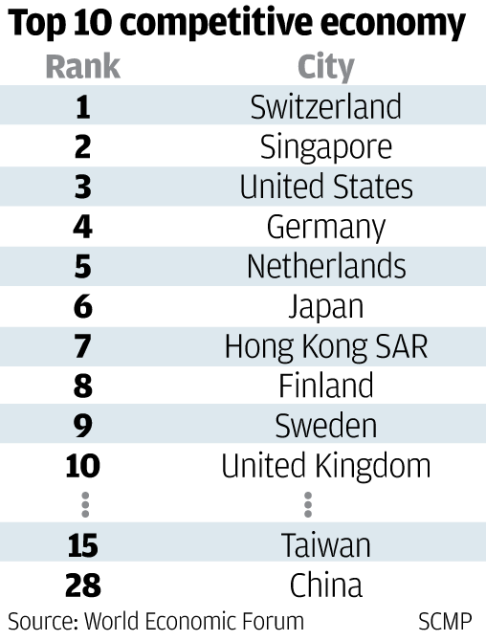
Hong Kong no longer has the best financial sector in the world, losing its top ranking to New Zealand and Singapore, according to the latest report from the World Economic Forum.

Despite losing its crown in finance, Hong Kong has held its place as the seventh most competitive economy in the world for the third year in a row in the 2015-16 World Economic Forum Global Competitiveness report, released on Tuesday.

The city maintained its top ranking for highest quality infrastructure in the world, while seeing a strong improvement in higher education and training, surging from 22nd place to 13th.

In addition, the report’s ranking for ‘quality of education’ jumped 19 places to be ranked 29th overall.

Despite the good news, Hong Kong dropped from first to third place in financial market development, mostly driven by a significant tumble in trustworthiness and confidence, which fell five places.

New Zealand is now ranked the best financial sector worldwide, closely followed by Singapore in second place.

“[Hong Kong’s] performance – almost unchanged from last year – is remarkably consistent across the 12 pillars,” the report stated.

“Although slipping from top place, its financial sector remains very well developed, with a high level of sophistication, trustworthiness and stability, and relatively good availability of credit.

“The challenge for Hong Kong is to evolve from one of the world’s foremost financial hubs to an innovative powerhouse.”

The report singled out innovation as one of the city’s weakest areas, ranking only 27th in the world in the category.

http://m.scmp.com/news/hong-kong/economy/article/1862665/hong-kong-loses-crown-worlds-best-financial-market-citys

The dark side of the mooncakes

by Joyce Lau

HarbourTimes.com| Hong Kong - Politics, Policy, Government ...Today, 11:46

Mooncakes’ subversive origins may have led to their sinister modern apparitions.  Mainland crackdowns on mooncake corruption and Hong Kong concerns on waste are the darkside of mooncakes – but there is a way to make it right.

Originally published September 5, 2014

Mooncakes have always been more about politics than food.

As folklore goes, Ming rebels used mooncakes to spirit around secret messages in a plot to overthrow their Yuan Dynasty rulers. Slips of paper baked into the cakes were allegedly used to prompt rebels to rise up on the 15th day of the eighth lunar month, which is when the Mid-Autumn festival is celebrated to this day.

Today, an entirely different kind of secret is being stuffed into the pastries, a de rigueurgift exchanged by Chinese families and businesses during the Mid-Autumn Festival, which starts this Monday evening.

Sinister mooncakes

According to media reports, luxury goods, precious metals, crystals and plain old wads of cash were stuffed into the cakes or slipped in their elaborate boxes, particularly in mainland China.

The issue became serious enough to attract the attention of global law firms. Baker & McKenzie issued a 2012 corporate compliance guide called “When is a Mooncake a Bribe?” This year, Norton Rose Fulbright followed up with “Moon cakes –guanxi or graft?”  In fact, mooncakes have been on the radar of Hong Kong’s Independent Commission Against Corruption (I.C.A.C.) since 2009, when a construction company director was jailed for two months for trying to bribe the police with mooncakes.  (The police returned them).

A 2013 RTHK report on a practice called “mooncake gambling” in Xiamen, Fujian Province, provided some background: “An influential official, or a businessman, receiving a box of mooncakes might often find something else inside – such as a high-end watch or gold coins.”

Some buyers didn’t even bother hiding the gold. The South China Morning Post reported in 2012 that a China Merchants Bank branch in Shanghai sold thousands of solid-gold mooncakes at 16,000 yuan each.

Finally, Beijing cracked down. Last year, they banned officials from using public funds for the purchase of mooncakes. This year, they are encouraging mooncake tattletales, with a “special tip-off window” on a government website for netizens to report the “squandering of taxpayers’ money by civil servants”. China Daily promised that mooncake-buying violators would be “named and shamed”.  In Hong Kong, mooncake corruption is not as prominent a problem. And – outside of politics – they are a genuinely important part of local culture.

Innocent mooncakes

Daisann McLane, the founder of Little Adventures in Hong Kong,  a private food tour company, often works with clients from the diplomatic community, and was featured in the U.S. Consulate’s newsletter.

She explained the importance of the pastries: “Mid-Autumn mooncakes are really the only gift-giving slot in Hong Kong’s calendar — the giving and receiving of them doesn’t carry the weight of other gifts at other times,” she said. “Nobody feels particularly uptight about receiving a box of mooncakes, and nobody is uptight about the wide practice of ‘re-giving’ boxes of mooncakes. In fact, I think people half expect you to give away the box they’ve just given you! (In that sense they are the Hong Kong version of Christmas fruitcakes). It’s an accepted practice of the Mooncake Economy.”

The problem here is not so much one of graft, but of waste. According to the NGO Green Power, this city threw out almost 1.8 million mooncakes in 2013 – which is only relatively better than the 2.5 million thrown out a few years prior.   

This is because the cake is seen mostly as a symbolic present  – far more are gifted in the name of tradition than can possibly be consumed. In fact, few younger consumers will eat more than their obligatory slice of mooncake, even though new-fangled flavors like ice cream or chocolate have gained in popularity.

If you are looking for the city’s top mooncakes at this late date, you are probably out of luck. The very high end ones – the ones handmade by chefs at Michelin-starred Chinese restaurants at five-star hotels – sell out in August. If you have a social or business meeting with a Chinese connection in the next few days, your best bet would be to get a mass-marketed box in the supermarket.

However, if you run a business or government agency in Hong Kong, you very likely have an ever-mounting pile in your office. Re-gifting is perfectly acceptable, but only up to the holiday date. Local support staff would be more than happy to have your extra boxes to give to their families.

Popular to give…and give again!

Diplomats and government officials overwhelmed with gifted mooncakes destined for the rubbish bin, can refer to the Environmental Protection Department’s list of charities that will take non-perishable mooncakes, though most groups will only take these donations today and tomorrow (Friday and Saturday, info on this page).

“Mooncakes are a little special,” said a spokeswoman from St. James’ Settlement People’s Food Bank (http://foodbank.sjs.org.hk).  “When people receive them after the festival, they don’t feel very good about it”. Mooncakes can be dropped off at Shop 1-3, G/F, Fortune Court, 10 Sai On Lane, Sai Ying Pun – but only until today (Friday).  She added that dry goods are welcome all year round. For more information, call 2975 8777.

The Salvation Army Hong Kong has already secured 22,000 donated mooncakes from companies and major donors this year, and will take individual mooncakes for distribution to the poor until Saturday.  For drop-off points, call 2783-2333 or click here.  [http://www.salvationarmy.org.hk/en/get_involved/programmes_detail/41]

The best way to celebrate the holiday is to go somewhere outdoors on Monday night. There are street-side dragon dances in neighbourhoods like Tai Hang, plus lantern displays outside the Cultural Centre in Tsim Sha Tsui and Victoria Park in Causeway Bay.

(The Hong Kong Tourism Board has a full list of events here:http://www.discoverhongkong.com/eng/see-do/culture-heritage/living-culture/tai-hang-fire-dragon-dance.jsp#ixzz3BaQwUeZq)

In a rather charming tradition, most of the city’s parks will be lit up with paper lanterns carried by local children and their parents. And, at least there, nobody will force you to gift – or eat – a mooncake.

Related

http://harbourtimes.com/2015/09/30/the-dark-side-of-the-mooncakes/

Leung vows to keep property curbs as Tsang signals some doubts

CY Leung (left, inset) says the government won't relax its property market curbs, while his finance chief John Tsang has signaled a more flexible approach. Photos: tvb.com, Reuters

The government will not scrap property cooling measures in the near term, Chief Executive Leung Chun-ying said on Tuesday, contrary to what Financial Secretary John Tsang appeared to suggest just a few days ago.

Leung vowed to continue the property curbs, saying the policies are needed in light of the current problems in the market even though there has been a slowdown in secondary housing transactions recently, Apple Daily reported.

The government will press on with efforts to dampen speculative purchases by overseas individuals and investors to keep home prices under control, he said.

Hong Kong had in the past few years put in place new rules such as Special Stamp Duty, Buyer Stamp Duty and Double Stamp Duty to deter speculative property buyers.

The measures came amid growing complaints from locals that housing was becoming ever more unaffordable despite a rise in supply of new units.

Leung’s comments Tuesday marked a different tone from that signaled by his finance chief Tsang.

In an interview Sunday after returning from a European trip, Tsang indicated that property curbs could be eased given the present macroeconomic situation.

Some policy adjustments may be made if the government finds it necessary to respond to the expected interest rate hike in the US, Tsang said.

Asked to clarify the government’s position, a spokesman for Tsang said there is no contradiction in the comments made by Leung and Tsang.

However, some observers, such as political commentator Ivan Choy Chi-keung, do not accept the explanation.

Choy said it is obvious that the views of Leung and Tsang on housing policies are different, and that the contradictory comments may have resulted from poor internal communication.

He also said that Leung’s comments suggest that he felt compelled to reaffirm the government’s stance, as he is worried that Tsang’s remarks could affect the chief executive’s prospects of securing a second term in office.

Lee Wing-tat, chairman of private think tank Landwatch, said Tsang’s view was more flexible and more appropriate in terms of policy considerations as the property market is more likely head south.

– Contact us at english@hkej.com

TL/AC/RC

http://www.ejinsight.com/20150930-leung-vows-to-continue-property-curbs-as-tsang-signals-some-doubts/?utm_source=rss&utm_medium=rss&utm_campaign=20150930-leung-vows-to-continue-property-curbs-as-tsang-signals-some-doubts

China Saved From the Threat of Johannes Chan

by Big Lychee

The NanfangToday, 12:03

To no-one’s great surprise, the University of Hong Kong council rejects law professor Johannes Chan’s appointment to pro-vice chancellor. Judging from the leaked account, the veto was carefully scripted: each council member who voted against gave neatly distinct reasons, which taken together left no possible stone unturned. Yet Chan himself and other key figures are reluctant to publicly call this a Chinese Communist Party hijacking of the university’s internal affairs. It’s as if Beijing’s agents had never hacked their HKU email accounts, or mounted a year-long anti-Chan smear campaign, or pressured pro-establishment or vulnerable council members and bystanders to fall into line or be silent.

The Liaison Office’s obsession with ensuring that this one low-to-medium-profile individual must not take this obscure-sounding university post is puzzling. Yes, there’s the kill-chicken-scare-monkeys thing. Obviously, the HKU-Occupy-Benny Tai connection made him a natural target, one that would impress the bosses in Beijing. But it doesn’t fully explain the sheer amount of effort in terms of snooping, propaganda and arm-twisting that went into this. Something deeply personal or pathological known only in the psychology of Stalinism is going on.

And it is bound to be counterproductive. The message is supposed to be: avoid incorrect political movements and ideas, or your career will suffer. Maybe some academics scrambling for research grants or tenure will succumb, unnoticed by the rest of us. Otherwise, this episode can only provoke yet more anti-Beijing sentiment within Hong Kong and suspicion about China abroad. The real message is: yes, we’re thugs.The real message is: yes, we’re thugs.

Council member Rosanna Wong (Dame Rosanna, sorry), HKU-grad and pre- and post-colonial do-gooder and all-purpose – and generally decent – busybody, said she voted no because she ‘worried that appointing Chan would split the school further’. I think this was her idea of a joke. If she had ‘…expected that rejecting Chan would increase the community’s love for the motherland’, it would have been a bit funnier, perhaps, but nice try.

Typically, Beijing’s local henchmen have a last laugh of their own, by leaving Rosanna and her buddies in their own doo-doo. After listing Johannes Chan’s every failing, they now have to find and approve a pro-vice chancellor who is demonstrably superior and adored by all stakeholders.

On the subject of irony, page 4 of the South China Morning Post describes how the US media highlighted the Pope rather than President Xi Jinping during the recent parallel visits, while the Mainland press pushed nothing but glowing coverage of Xi’s tremendous popularity and impact in the US. And page 12 of the SCMP has, well, nothing but glowing coverage of Xi’s tremendous popularity and impact in the US…

Meanwhile, away from the SCMP, some investigative reporting to read – more Howard Winn on the Zhuhai Bridge ‘moving island’ mystery/screw-up. He reveals that ‘…[insurance] loss adjusters have been appointed, which suggests matters are not as ‘normal’ as the government would have us believe…’

I declare the National ‘love the motherland’ Day midweek mini-weekend open with a challenge: name one thing that is as ‘normal’ as the government would have us believe?

The post China Saved From the Threat of Johannes Chan appeared first on The Nanfang.

https://thenanfang.com/china-saved-from-the-moral-threat-of-johannes-chan/

Chinese Culture Slowly Infiltrating American Life

by Charles Liu

The NanfangToday, 12:14

Chinese have long since established a strong presence in the United States, having established Chinatowns throughout the country and otherwise bringing Chinese culture to the West.

Although this process began a long time ago, consider that China’s relationship with the West really only began in 1972, when US President Nixon visited China and re-established formal diplomatic ties, sparking a wave of change that continues to resonate today.

China Daily documented China’s “soft power” infiltration into the lives of ordinary US citizens by way of a convenient infographic:

Infographic: The Chinese elements presented in the day to day life of an average American

On September 22, Chinese President Xi Jinping began his first state visit to the USA. It has been 36 years since China and the United States re-established diplomatic relations and, in that time, both countries have been enriched by the other. The following infographic will better allow us to understand how Americans incorporate Chinese culture, or elements, into their daily lives.

When talking about China, what do Americans think of?

Do they only think of these things? No!

As China’s economy opened to the world, Americans became more familiar with Chinese culture. 

Chinese cuisine became fashionable

Hot pot, noodles, dumplings, spring rolls, roujiamo (meat paste on unleavened bread), crushed cucumbers…Americans are having a love affair with Chinese food, and they just adore the hot and spicy!

Americans have learned, and can identify several Chinese national brands, such as Huawei, Haier, Air China, and DFM Automotive (above left).  

The Chinese character for “good fortune” represents happiness, peace and prosperity (above right). Even though there are differences between Americans and Chinese, each nation’s citizens can appreciate, and even strive for a beautiful life. 

Apart from this, what else is there? (left to right, top to bottom)

“Kung Fu Panda is so cute!”
“The Chinese are so amazing at ping pong!”
“The last time I ate hotpot in Chinatown, it was so spicy!”
“I learned several characters of Chinese calligraphy at the Confucius Institute! It’s so interesting~”
“That Mulan is so courageous. Chinese women are so beautiful!”
“Hey, can someone explain to me what ‘chunyun‘ means?” (“Chunyun” means “Spring Festival travel rush”, a busy time of travel in China analogous to the Christmas or Thanksgiving holiday travel in the USA)
“If I were to visit China, I want to see how big the Forbidden City is!”
“I’ve heard it has become fashionable to get Chinese characters for tattoos. I’ve gotten one too, but it seems like… is this wrong?”*

*(last picture in lower right) “女礻申” doesn’t mean anything in Chinese, because it’s a misspelling of “女神”, meaning “female goddess” or “beautiful woman”.

You can see the entire infographic in full here.

The post Chinese Culture Slowly Infiltrating American Life appeared first on The Nanfang.

https://thenanfang.com/us-americans-adopted-chinese-culture-daily-lives/

Don’t Worry, Columnist Says Chinese Will Soon Become “Model Tourists” Like the Japanese

Bad Behaviour Abroad

Don’t Worry, Columnist Says Chinese Will Soon Become “Model Tourists” Like the Japanese

Because Chinese are just like Japanese. No, really

 Charles LiuSeptember 30, 2015 12:22pm

With the National Day holiday arriving soon and millions of Chinese looking to travel abroad, it’s likely that we’ll again see more examples of Chinese tourists misbehaving. And yet, an op-ed from China Daily tells us that these days are almost over.

In an article called “Chinese could soon become model tourists”, Zhang Zhouxiang tells us that not only is the bad reputation of Chinese tourists unfair, but that it won’t matter in the long run since Chinese tourists won’t be associated with this much longer.

To explain, Zhang brings up the bad rap that Japanese tourists were given back in the 60s and 70s when they “rushed into shops to buy luxuries”, saying “When people from populous countries start traveling abroad in large numbers, it is likely that their behavior, rooted in their cultures, will be criticized.” Zhang writes:

Today, Japanese tourists, accustomed to the nuances of Western customs and social norms, are among the most polite tourists in the world. As such, it should not take a long time for Chinese tourists to become one of the best behaved in the world.


No further explanation was provided as to how China will achieve this feat. In fact, this was the last line in his op-ed.

The rest of the article goes more into detail on cultural differences between East and West that act to escalate tensions. To give an example, Zhang writes about Chinese dining etiquette that may be unfamiliar to foreigners, commonly referred to by the Chinese public and media as laowai, or “venerable outsider”:

Chinese tourists have earned a bad name also for dining in large groups. Even in restaurants where tables are arranged separately, they sometimes put tables together to make a bigger one so that they can dine together in a large group. This is not surprising, because Asians, Chinese in particular, consider dining in large groups to be auspicious. Do not isolate anyone — that’s part of Chinese social philosophy.


Zhang further explains that cultural differences give rise to frictions over differences of what individual cultures determine to be “rude”. However, the way that Zhang describes Chinese culture seems to imply a society for which nothing is “rude” save that which contradicts Chinese customs. Although some Chinese may take offence to queue jumping, talking loudly and spitting in public, Zhang refuses to condemn such behavior. “Some media outlets have even termed their behaviors… as rude,” Zhang writes.

In whichever way Chinese tourists soon become the model tourists that Zhang suggest, it will be done selflessly for the good of the world:

But when reminded of Western customs, most Chinese tourists are ready to temporarily sacrifice their traditional beliefs to suit the environment.


One case that made the news recently happened late last Saturday night, when Chinese tourists Rong Jiaxin and wife Zhao Xinyu were enjoying their honeymoon in Sapporo, Japan. They decided to treat themselves by going to a downtown convenience store. But when Zhao opened an ice cream while inside the store without first paying for it, the convenience store clerk took offense. Knowing no Chinese, the clerk used hand gestures to tell the newlyweds to leave the premises immediately.

Well, that was the beyond the pale for Rong. As he told police afterwards, Rong felt his wife had been insulted and needed to protect her. That’s why he pulled the clerk’s hair and assaulting him with kicks, injuring his face and nose.

The newlyweds have since been arrested by Sapporo police.

As Zhang wrote at the beginning of her article, “the media have been reporting one incident after another of the uncivil behaviors of some Chinese tourists overseas.” And while this may be just one more such example, “it is unfair to condemn Chinese tourists as a whole for the bad behaviors of just a few.”

To uphold his traditional beliefs of honor and loyalty, Rong was willing to go to any lengths to protect his new bride. While other Chinese are willing to sacrifice their long-held beliefs when traveling abroad, it seems that those unwilling to comply are going to do so at any cost.

In the meantime, we’ll await the quick change for Chinese to become the model tourists that Zhang speaks of.

Source: Global TimesChina Daily,People's Daily Online

Photos: Japan Times

Tags: China Dailychinese tourists,Japanop-edsouth koreantourists behaving badly


Charles Liu

The Nanfang's Senior Editor

More stories

https://thenanfang.com/china-daily-chinese-soon-become-model-tourists/

The Leader of China Brought a Little of China With Him to New York

By Larry OngEpoch Times | September 29, 2015

Last Updated: September 29, 2015 4:35 pm

Chinese people who oppose the Chinese Communist Party (CCP), many of them who've had their land confiscated by authorities, are harassed by supporters of the CCP by blocking their messages with Chinese flags near the Waldorf Astoria on Lexington Ave. between 48th Street and 47th Street in New York where Chinese Communist Party leader Xi Jinping is staying, on Sept. 26, 2015. Supporters of the CCP try to cover Fu Yuxia with the Chinese flag in an attempt to block her message (President Xi Jinping, Stop and Meet us, the Chinese Petitioners. Listen to us and Solve our Problems!!!). (Samira Bouaou/Epoch Times)

Fu Yuxia and her 7-year-old niece Fu Yuxia are harassed by supporters of the Chinese Communist Party (CCP) while exposing land confiscation by authorities, near the Waldorf Astoria on Lexington Ave. between 48th Street and 47th Street in New York where Chinese Communist Party leader Xi Jinping is staying, on Sept. 26, 2015. (Samira Bouaou/Epoch Times)

Chinese people who oppose the Chinese Communist Party (CCP), many of them who've had their land confiscated by authorities, are harassed by supporters of the CCP by blocking their messages with Chinese flags near the Waldorf Astoria on Lexington Ave. between 48th Street and 47th Street in New York where Chinese Communist Party leader Xi Jinping is staying, on Sept. 26, 2015. (Samira Bouaou/Epoch Times)

Chinese people who oppose the Chinese Communist Party (CCP), many of them who've had their land confiscated by authorities, are harassed by supporters of the CCP by blocking their messages with Chinese flags near the Waldorf Astoria on Lexington Ave. between 48th Street and 47th Street in New York where Chinese Communist Party leader Xi Jinping is staying, on Sept. 26, 2015. (Samira Bouaou/Epoch Times)

Chinese people who oppose the Chinese Communist Party (CCP), many of them who've had their land confiscated by authorities, are harassed by supporters of the CCP by blocking their messages with Chinese flags near the Waldorf Astoria on Lexington Ave. between 48th Street and 47th Street in New York where Chinese Communist Party leader Xi Jinping is staying, on Sept. 26, 2015. (Samira Bouaou/Epoch Times)

Chinese people who oppose the Chinese Communist Party (CCP), many of them who've had their land confiscated by authorities, are harassed by supporters of the CCP by blocking their messages with Chinese flags near the Waldorf Astoria on Lexington Ave. between 48th Street and 47th Street in New York where Chinese Communist Party leader Xi Jinping is staying, on Sept. 26, 2015. (Samira Bouaou/Epoch Times)

Chinese people who oppose the Chinese Communist Party (CCP), many of them who've had their land confiscated by authorities, are harassed by supporters of the CCP near the Waldorf Astoria hotel on Lexington Ave. between 48th Street and 47th Street in New York where Chinese Communist Party leader Xi Jinping is staying, on Sept. 26, 2015. Li Fang Ge whose Shanghai home was robbed by the government in 2001, was beaten by police along with her parents in 2003 when they decided to appeal. Supporters of the CCP surrounded and covered her with the Chinese flag in an attempt to block her message and photos of her and her beaten parents. (Samira Bouaou/Epoch Times)

Li Fang Ge whose Shanghai home was robbed by the government in 2001, was beaten by police along with her parents in 2003 when they decided to appeal. In an attempt to block her message and photos of her and her beaten parents, supporters of the Chinese Communist Party (CCP) surrounded and covered her with the Chinese flag near the Waldorf Astoria hotel on Lexington Ave. between 48th Street and 47th Street in New York where Chinese Communist Party leader Xi Jinping is staying, on Sept. 26, 2015. (Samira Bouaou/Epoch Times)

Li Fang Ge whose Shanghai home was robbed by the government in 2001, was beaten by police along with her parents in 2003 when they decided to appeal. In an attempt to block her message and photos of her and her beaten parents, supporters of the Chinese Communist Party (CCP) surrounded and covered her with the Chinese flag near the Waldorf Astoria hotel on Lexington Ave. between 48th Street and 47th Street in New York where Chinese Communist Party leader Xi Jinping is staying, on Sept. 26, 2015. (Samira Bouaou/Epoch Times)

Chinese people who oppose the Chinese Communist Party (CCP), many of them who've had their land confiscated by authorities, are harassed by supporters of the CCP by blocking their messages with Chinese flags near the Waldorf Astoria on Lexington Ave. between 48th Street and 47th Street in New York where Chinese Communist Party leader Xi Jinping is staying, on Sept. 26, 2015. (Samira Bouaou/Epoch Times)

NEW YORK—For tens minutes on Sept. 26, a scene more commonly witnessed in the Middle Kingdom surreally played out in a corner of Manhattan’s plush hotel district.

As a motorcade thought to be carrying Chinese Communist Party chief Xi Jinping drove past a street junction on Lexington and 49th at about 2:00 p.m., about a dozen Chinese women and men in light sweaters suddenly dashed from the sidewalk and onto the street.

“Return my property! Give me justice!” they yelled; “My ancestors’ land doesn’t belong to the communists!”; or simply “Help! Help!” One sign, in Chinese and English, said: “Chinese Communist Party, return the property stolen from us!!!” while another asked the local government in the coastal metropolis of Shanghai to return their homes and human rights.

Chinese people who oppose the Chinese Communist Party (CCP), many of them who’ve had their land confiscated by authorities, are harassed by supporters of the CCP by blocking their messages with Chinese flags near the Waldorf Astoria hotel on Sept. 26, 2015. (Samira Bouaou/Epoch Times)

The men in dark suits weren’t far behind, lurching forward with big Chinese flags and small American flags. After a brief scrimmage, they had successfully disabled a number of the protesters by wrapping them up in their red flags.

Chinese people who oppose the Chinese Communist Party (CCP), many of them who’ve had their land confiscated by authorities, are harassed by supporters of the CCP by blocking their messages with Chinese flags near the Waldorf Astoria hotel on Sept. 26, 2015. (Samira Bouaou/Epoch Times)

Chinese people who oppose the Chinese Communist Party (CCP), many of them who’ve had their land confiscated by authorities, are harassed by supporters of the CCP near the Waldorf Astoria hotel on Sept. 26, 2015. (Samira Bouaou/Epoch Times)

In an off-white neck brace and red jacket, Fu Yuxia stood in the streets with her 7-year-old niece Fu Yuxing and held aloft the sign “President Xi Jinping, Stop and Meet us, the Chinese Petitioners. Listen to us and Solve our Problems!” Aunt and niece quickly found themselves pushed onto the sidewalk by several of the assailants, who then surrounded them with red flags.

Fu Yuxia and her 7-year-old niece Fu Yuxia are harassed by supporters of the Chinese Communist Party (CCP) while exposing land confiscation by authorities, near the Waldorf Astoria hotel on Sept. 26, 2015. (Samira Bouaou/Epoch Times)

An Epoch Times photographer captured photographs of the bewildered 7-year-old surrounded by aggressive Chinese men with gigantic red flags, trying to wrap her and her aunt up.

When the motorcade was out of earshot, the flag-bearing attackers suddenly dispersed and left the protesters as they were.

Speaking to Epoch Times after the incident, Li Fangge said that the protesters were from Shanghai, and had suffered persecution by the Chinese authorities for petitioning the loss of their property, which was forcibly seized from them in the early 2000s. They had spent many years seeking compensation from the local government and in Beijing, but were always rebuffed, often times violently.

Li Fang Ge whose Shanghai home was robbed by the government in 2001, was beaten by police along with her parents in 2003 when they decided to appeal. (Samira Bouaou/Epoch Times)

Li and her parents even received a brutal beating after one petition session in 2003. To an Epoch Times photographer, Li showed pictures of her and her parents with large, angry-looking black bruises on their arms and thighs.

The men with flags were led by a Mr. Yang from the Consulate General of the People’s Republic of China in New York, according to what could be divined from interviews with individuals on the scene.

Chinese leader Xi Jinping was staying at the Waldorf Astoria on Park Avenue during the final leg of his first state visit to the United States.

Xi spoke at a United Nations session at its headquarters on Sept. 27, a day after the attack on the petitioners, and on Sept. 28 made his inaugural address to the UN General Assembly on its 70th anniversary celebrations.

Chinese leader Xi Jinping addresses the UN General Assembly in New York City on Sept. 28, 2015. (John Moore/Getty Images)

“China will continue to participate in building world peace,” he said.

With reporting by Samira Bouaou and Shi Ping.

http://www.theepochtimes.com/n3/1778508-the-leader-of-china-brought-a-little-of-china-with-him-to-new-york/

US-China Cyberpact: A Deal Built on Distrust

By Joshua PhilippEpoch Times | September 29, 2015

Last Updated: September 29, 2015 9:20 pm

President Barack Obama (L) shakes hands with Chinese Communist Party leader Xi Jinping at the White House on Sept. 25. (JIM WATSON/AFP/Getty Images)

The cybersecurity deal between the United States and China is a deal without trust. With the United States threatening sanctions and declaring that its patience for Chinese cyberattacks had reached an end, the leader of the Chinese Communist Party (CCP), Xi Jinping, agreed to end cyberattacks that have been stealing trillions in value annually from the U.S. economy.

The agreement is being viewed with a sort of pessimistic hope in the cybersecurity community.

“My opinion is, I’ll believe it when I see it,” said Darren Hayes, director of cybersecurity and an assistant professor at Pace University, in a phone interview.

While some experts believe the threat of sanctions against Chinese companies is too large for the CCP not to comply, the CCP has a track record of saying one thing and doing another.

“I know it’s a priority for the U.S. government, because they estimate that trillions of dollars have been stolen, but this agreement lacks credibility,” said Hayes.

Obama and Xi announced the agreement during a joint press conference on Sept. 25, and drew a distinction between spy operations meant for economic gain, and those meant solely for espionage.

They agreed, Obama said, that neither country will “conduct or knowingly support cyberenabled theft of intellectual property, including trade secrets or other confidential business information for commercial advantage.”

Obama said he told Xi “the question now is, are words followed by actions.”

Oversight for Cyberspies

The cyberagreement will establish a system for high-level dialogue between the United States and the CCP. On the U.S. side, this will include U.S. secretary of homeland security and the U.S. attorney general. The CCP will assign an official at the ministerial level. Other departments, including the FBI, the Department of Homeland Security, and Chinese offices with similar roles, will take part.

According to a White House fact sheet, this biannual dialogue will be used as a mechanism “to review the timeliness and quality of responses” if an incident takes place. In other words, if the United States detects a cyberattack being used to steal from a business, they will alert the CCP, and participants in the dialogue will review whether the CCP did anything about it.

Despite the oversight, on the surface the agreement appears to be toothless. Yet, deep down this may not be the case.

The context of the agreement is what’s important, according to Dmitri Alperovitch, co-founder and CTO of Crowdstrike, a cybersecurity technology company.

The CCP realized, he said in a phone interview, “if they didn’t concede on these points that sanctions would have been put on Chinese companies.”

While it doesn’t appear sanctions are mentioned directly in the agreement, the United States is reserving them as an option if the CCP’s use of cyberattacks for theft continue.

Obama hinted at this during the joint press conference with Xi. He said, “We will be watching carefully to make an assessment as to whether progress has been made in this area.”

If the CCP doesn’t comply, Obama said, sanctions and other retaliatory options are still on the table. He said, “I did indicate to President Xi that we will apply those and whatever other tools we have in our toolkit to go after cybercriminals, either retrospectively or prospectively.”

New Targets

One of the main problems the CCP faces is that its systems for economic theft are massive, and deeply entwined with its programs for economic growth.

Epoch Times recently exposed this system in an investigative report. The CCP’s economic theft is directed by legislation, and carried out by large-scale networks of military and private hackers. Stolen information is reverse engineered by a network of hundreds of “technology transfer centers” under government and academic offices. The system is also supported by more than 3,200 military front companies operating in the United States.

“We’re talking about tens of thousands of people involved in doing this for the Chinese government, and to say this is going to stop today or tomorrow is absurd,” said Hayes.

According to Alperovitch, however, the CCP may not need to dismantle this system. He believes the program could solve the problem of economic theft in the United States, but said Chinese hackers will still have plenty of targets to choose from.

Alperovitch said the CCP is unlikely to dismantle its network of military hackers. Instead, “They’re just going to give them new tasks.”

“It’s not going to cut down on all espionage,” he said, noting that we will likely see an increase in cyberattacks that fall under conventional espionage—and there will likely be an increase of Chinese cyberattacks against other countries.

The issue rests in two key elements of the agreement. First off, the agreement is currently only between the United States and China—and the CCP’s operations to steal intellectual property could simply turn their sights on businesses outside the United States.

Second, the agreement doesn’t cover cyberattacks that fall under the definition of old-fashioned espionage.

“The line is it has to be for commercial benefit,” Alperovitch said.

This means that cyberattacks stealing U.S. military blueprints, personal data on federal employees, and cyberattacks monitoring U.S. officials and other persons of interest will not only not end, but may even increase.

MORE:EXCLUSIVE: How Hacking and Espionage Fuel China’s GrowthChina’s Latest Cyber Gambit: Xi Jinping’s Tech Conference in SeattleMurder, Money, and Spies Investigative Series

“I think the hope was just to curtail commercial espionage,” Alperovitch said. “There’s absolutely nothing you could do to stop the Chinese from stealing the blueprints from the F-35 [fighter jet].”

Obama emphasized this key differencein operations during a Sept. 16 business roundtable.

He said the United States has told the CCP, “We understand traditional intelligence gathering functions that all states, including us, engage in,” yet noted “that is fundamentally different from your government or its proxies engaging directly in industrial espionage and stealing trade secrets.”

http://www.theepochtimes.com/n3/1777875-a-deal-built-on-distrust/

Hong Kong university a study in politics of academia amid disputed appointment of Johannes Chan

Decision-makers at University of Hong Kong are torn between Beijing and pan-democrats over pro-democracy scholar Johannes Chan

NG KANG-CHUNG AND JOYCE NG

PUBLISHED : Wednesday, 30 September, 2015, 12:01am

UPDATED : Wednesday, 30 September, 2015, 1:58am

In the end, HKU's governing council last night rejected Chan's appointment by 12 votes to eight. Photo: Felix Wong

Rarely is the appointment of a pro-vice-chancellor at a university as controversial and politicised as that of former law dean Professor Johannes Chan Man-mun's.

Either way, the University of Hong Kong was trapped in a lose-lose situation: if the institution's top decision-makers endorsed Chan, they would be accused of bowing to political pressure from pan-democrats; if his candidature was not approved, they would still be seen as yielding to pressure - from Beijing.

"Outside forces are trying to pressure the university," political analyst Dr Chung Kim-wah, of Polytechnic University, said.

"No matter which side wins, the only result is that the reputation of the university is hurt as institutional autonomy comes under threat."

In the end, HKU's governing council last night rejected Chan's appointment by 12 votes to eight.

Apparent political leanings within the council were exposed soon afterwards by Billy Fung Jing-yen, president of HKU's student union who, as a council member, was privy to the comments of pro-government members at the closed-door talks.

According to Fung, Professor Arthur Li Kwok-cheung noted Chan did not have a PhD degree and was recommended "only because he was a nice guy".

Leoni Ki Man-fung, Margaret Leung Ko May-yee and Benjamin Hung Pi-cheng were cited as saying Chan had revealed to the media he was selected before the recruitment process ended.

Chan had written a newspaper article saying he sensed political interference after rumours that he was shortlisted.

Edward Chen Kwan-yiu was quoted as saying Chan seldom published in academic journals and questioning his ability to process job applications filed to HKU, as many would be PhD holders.

According to Billy Fung, Professor Arthur Li Kwok-cheung noted Chan (above) did not have a PhD degree and was recommended "only because he was a nice guy".Chen later rebuked Fung and denied having said anything about PhDs.

Lo Chung-mau, who was admitted to hospital after students stormed the council's July talks, allegedly said he was upset Chan "did not send him regards" and his academic achievements were "not even comparable to an assistant professor's".

Martin Liao Cheung-kong was quoted as saying he found on the Google Scholar search engine that Chan had published only four articles in the last five years. Liao later clarified that Fung "didn't understand what I said".

Rosanna Wong Yick-ming said Chan was a divisive figure and his appointment would split the university, according to Fung.

On the lack of a PhD, Chan's supporters and colleagues earlier said that unlike in other disciplines, common-law scholars had no tradition of pursuing PhDs.

The appointment saga could be traced back to 2013 when the HKU council decided to revive the post of pro-vice-chancellor for academic staffing and resources, after a similar position remained vacant for five years.

The office holder, according to HKU, is "responsible for developing the university's policies and processes in academic resource allocation, inclusive of financial resources, and all facets of faculty recruitment, retention and professional development".

City University political scientist Dr James Sung Lap-kung said: "It is such a powerful post that the last thing Beijing wants is to let it fall into the hands of a pan-democrat-friendly person."

A global recruitment exercise began and a council-appointed search committee picked Chan late last year, subject to the council's formal approval - usually a procedural endorsement.

Before his job could be cast in stone, however, Chan was accused of mishandling a donation passed on from a colleague, Occupy Central co-founder Benny Tai Yiu-ting. Part of the HK$1.45 million in donations was used for Occupy-related activities.

With that, what should have been an academic affair became politicised and degenerated into open confrontation between Beijing loyalists and pan-democrats.

Ahead of last night's meeting, council member Dr Cheung Kie-chung said: "Damage done cannot be undone. The best way is to follow the established procedure to confirm the recommendation of the search committee.

"If we do not trust the committee's decision, why should we appoint it in the first place?"

http://m.scmp.com/news/article/1862573/hong-kong-university-study-politics-academia-amid-disputed-appointment-johannes

Outdated MTR by-laws behind recent baggage disputes, lawmaker James To says

Proposed amendments to regulations were not followed through, the Democratic Party legislator says

SAMUEL CHANsamuel.chan@scmp.com

PUBLISHED : Wednesday, 30 September, 2015, 12:01am

UPDATED : Wednesday, 30 September, 2015, 1:28am

Passengers carry large luggages on MTR at Tai Wai Station. Photo: Edward Wong

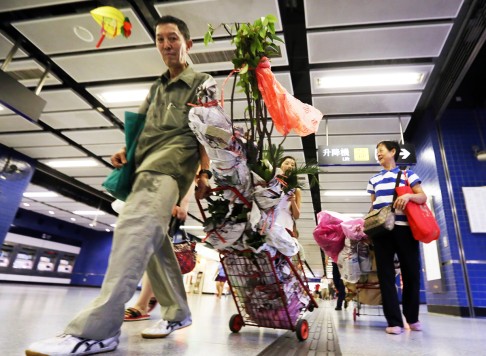
Recent rows over how the MTR Corporation enforced its by-laws governing baggage size could have been prevented had the government honoured a promise in 2010 to review regulations of the railway operator, a lawmaker said yesterday.

The regulations, known as the Mass Transit Railway By-Laws, were sometimes ambiguous and so outdated that, if strictly enforced, they could lead to more "absurd" situations, James To Kun-sun of the Democratic Party warned.

Instances of ambiguous by-laws were the prohibition of an "attempt to consume any food or beverage" and the use of foul language, To said.

"Take loitering as an example. The act itself is illegal under the MTR by-laws," he said.

"But outside MTR premises, the act of loitering per se is not illegal; only loitering with a criminal intent is illegal. So the same act is legal above the ground but illegal underground."

The MTR Corp triggered public outrage for intercepting three student commuters within a week this month for carrying bulky musical instruments - a guzheng, or Chinese zither, in the first case and a cello in the other two cases - while allegedly being more lenient towards parallel-goods traders from the mainland.

Areas that To said needed improvements included creating signs that were clearly understandable to everyone, even people who could not read Chinese or English.

He also urged the government to accept "long overdue" amendments similar to those he had proposed for by-laws governing other locations - the Kai Tak airport and Ocean Park.

To was referring to a proposal he laid out in 2007 to revise the MTR by-laws.

Then transport minister Eva Cheng had promised a full review of the by-laws within 12 months after the MTR's merger with the Kowloon-Canton Railway Corporation.

In 2010, the government proposed in a 70-page report the revisions to be made and designated September 1, 2010, as the date of implementation, the lawmaker said.

Since then, however, it had been stalling on the issue, and this May, the Legislative Council was informed the government considered the amendments "not necessary".

Last night, the Transport and Housing Bureau reiterated the government's written response to Legco in May that it considered revisions to the by-laws "not necessary".

http://m.scmp.com/news/article/1862545/outdated-mtr-laws-behind-recent-baggage-disputes-lawmaker-james-says

Hong Kong Television Network rejected over its bid to operate mobile TV programmes

JULIE CHUjulie.chu@scmp.com

PUBLISHED : Wednesday, 30 September, 2015, 2:40am

UPDATED : Wednesday, 30 September, 2015, 2:40am

HKTV and Hong Kong Mobile Television Network Limited (HKMTV), both chaired by media tycoon Ricky Wong Wai-kay (above), sought a judicial review against the Communications Authority's ruling that the companies would need to apply for a television licence if their mobile station targeted more than 5,000 "specified premises". Photo: Nora Tam

A High Court judge has rejected a judicial review brought by Hong Kong Television Network (HKTV) over its failed bid to operate a mobile television system through a digital format.

HKTV and Hong Kong Mobile Television Network Limited (HKMTV), both chaired by media tycoon Ricky Wong Wai-kay, sought a judicial review against the Communications Authority's ruling that the companies would need to apply for a television licence if their mobile station targeted more than 5,000 "specified premises".

Mr Justice Thomas Au Hing-cheung wrote in his judgment that he found the overall intent of the ordinance was to protect children and public morals by regulating the content of television programmes through a licensing system.

The two companies could not argue they were operating a "mobile station" and the requirement was not applicable to them, the judge ruled. "I do not think the [authority] has committed any error of law in construing the meaning of the audience requirement," he wrote.

The court was told that HKTV acquired China Mobile Hong Kong, which had been issued a unified carrier licence to provide mobile television services in Hong Kong, and changed its name to HKMTV in 2013.

In January last year, HKMTV announced that it intended to adopt the Digital Terrestrial Multimedia Broadcast (DTMB) transmission standard for its proposed mobile television service.

But the authority informed HKMTV that it had first to obtain a domestic television service licence.

In response to the court judgment, HKTV said: "The company is seeking legal advice on grounds to appeal."

A spokesman for the Communications Authority welcomed the ruling.

http://m.scmp.com/news/hong-kong/article/1862533/hong-kong-television-network-rejected-over-its-bid-operate-mobile-tv

Working poor households increase alarmingly despite Hong Kong government's attempts to reduce poverty since 2013

JENNIFER NGOjennifer.ngo@scmp.com

PUBLISHED : Wednesday, 30 September, 2015, 4:17am

UPDATED : Wednesday, 30 September, 2015, 4:17am

A woman and her son in a subdivided flat. About 1.34 million Hong Kong people live below the poverty line.Photo: Reuters

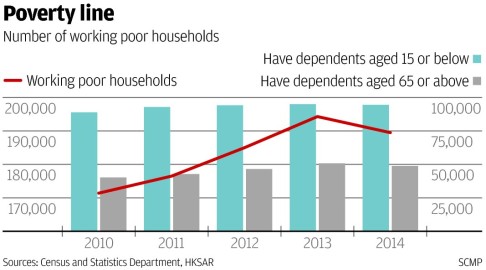
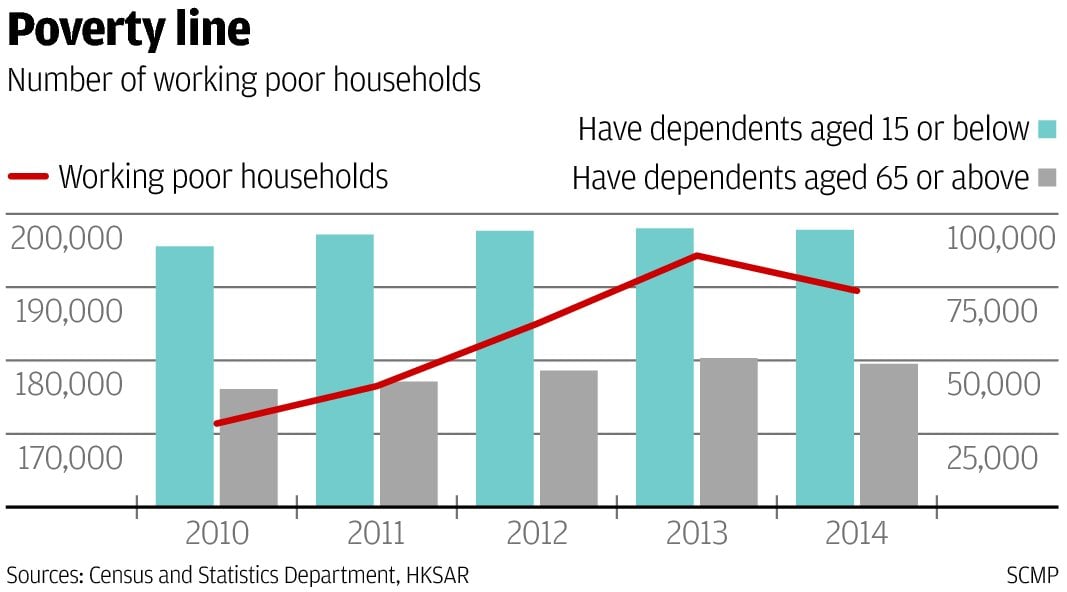
The number of working poor families - households living under the poverty line with at least one member holding down a job - increased by 10 per cent in five years to 190,000 families, even though the government claims to have been tackling the problem since 2013.

An Oxfam Hong Kong report pointed out that another 18,100 families have fallen into poverty, taking the total number of people in working poor households to 647,500 - accounting for half of Hongkongers living below the poverty line.

While living has become harder for the working class, Hong Kong's richest 1 per cent held half of the city's wealth last year, the report also indicated.

The 25 richest Hongkongers have amassed HK$1.513 trillion - more than the Hong Kong government's reserves of HK$1.5 trillion.

"Since [the government] was supposedly dealing with the poverty issue in the past few years, the number should be on the decrease. To have a double-digit rise is quite a lot, and means that what we've done so far is not enough," said Oxfam programme manager Wong Shek-hung.

Wong attributed the problem to bad labour policies, including a minimum wage that is not sufficient to meet the basic needs of living in the city and cover inflation, and the mandatory provident fund (MPF) offset mechanism - where the practice of using MPF contributions intended for retirement to offset severance and long-service payments - which has long been seen as unfair to employees.

From next year, the government is set to pay low-income family assistance to working poor families with children. But Wong said although it was welcome, it would not be enough to deal with the poverty issue.

Labour Party lawmaker Lee Cheuk-yan said poverty among workers was created by the government because of skewed labour policies.

"The MPF offset won't make someone poor immediately," he said.

"But when you retire, you can immediately fall into poverty. It's a delayed problem but it will be huge when it happens."

Lee also criticised the government for reviewing its policy on the minimum wage only once every two years, while inflation rises every year.

Wong Hung, associate professor of social work at the Chinese University, said the 10 per cent increase was an obvious surge and evidence that Hong Kong had changed. Holding a job would not necessarily provide enough to cover living expenses, he noted.

"In the past five years our economy hasn't been bad and the unemployment rate has been low, but the jobs available do not pay well, and there is low labour protection," said Wong.

"Most are contract or part-time jobs. This explains why there are more working poor."

Of the number of working poor, only 7.5 per cent are on welfare - Comprehensive Social Security Assistance - while 53.6 per cent live on a monthly income of less than the average welfare payment.

Around 1.34 million Hongkongers live below the poverty line, which is set at half the median household income for each household size.

http://m.scmp.com/news/hong-kong/economy/article/1862580/working-poor-households-increase-alarmingly-despite-hong-kong

Hongkongers' trust in CY Leung and Beijing at a lower point now than during Occupy Central

Drop comes after Beijing's top man in HK said chief executive has special legal status

GARY CHEUNGgary.cheung@scmp.com

PUBLISHED : Wednesday, 30 September, 2015, 2:40am

UPDATED : Wednesday, 30 September, 2015, 2:40am

The poll was conducted by the university's Institute of Asia-Pacific Studies from Monday to Thursday last week, just over a week after Zhang Xiaoming (right), director of Beijing's liaison office, said the chief executive was in a "special legal position that transcended" the executive, the legislature and the judiciary. Chief Executive Leung Chun-ying scored 40.1 out of 100 overall on his performance, down from 42.7 last month. Photo: Felix Wong

Hongkongers' trust in the central government is at its lowest in a year amid a recent claim by Beijing's top man in the city that the chief executive has a special legal status "transcending" all three branches of government, a Chinese University poll shows.

Only 21.5 per cent of the 762 respondents indicated "trust" in Beijing, down from 25.6 per cent last month, according to the poll findings, released yesterday.

The percentage was at its lowest since last September , when only 19.8 per cent expressed trust in the central government.

In terms of distrusting Beijing, 40.6 per cent said yes this time, up from 34.9 per cent last month.

The poll was conducted by the university's Institute of Asia-Pacific Studies from Monday to Thursday last week, just over a week after Zhang Xiaoming, director of Beijing's liaison office, said the chief executive was in a "special legal position that transcended" the executive, the legislature and the judiciary.

Zhang also said the concept of separation of powers was confined to sovereign states and could only serve as a reference for Hong Kong. His remarks sparked public fears Beijing was tightening its grip on the city's affairs.

In the same Chinese University poll, Chief Executive Leung Chun-ying scored 40.1 out of 100 overall on his performance, down from 42.7 last month.

It was also his lowest score since October last year, when he got 38.6. The poll had a sampling error of plus or minus 3.55 percentage points at 95 per cent confidence level.

Similarly, a separate poll conducted by the University of Hong Kong's public opinion programme found the number of respondents who would cast a vote of confidence in Leung had fallen to 20 per cent, from 25 per cent in the last survey in June.

Out of 100, Leung scored 39.2 in his popularity rating, down from 41.4, according to the September 16-22 poll, in which 1,018 people were interviewed.

It also found a sharp fall in public satisfaction in five major policy areas of the government. Only 22 per cent of respondents were satisfied with the government's efforts in improving livelihoods, down 12 percentage points from June.

The satisfaction rate for the government's work in maintaining economic prosperity fell from 36 per cent to 29 per cent.

The sampling error of the HKU poll was plus or minus 4 percentage points at 95 per cent confidence level.

Additional reporting by Ng Kang-chung

http://m.scmp.com/news/hong-kong/politics/article/1862534/hongkongers-trust-cy-leung-and-beijing-lower-point-now

HKU Council to discuss Billy Fung's actions

  • Leong Che-hung says a meeting will discuss the breaking of confidentiality rules by Billy Fung. Photo: RTHK
    Leong Che-hung says a meeting will discuss the breaking of confidentiality rules by Billy Fung. Photo: RTHK
HKU Council chairman, Leong Che-hung, said a meeting will be held to discuss the breaking of the confidentiality rules by the president of the university's student union, Billy Fung, who on Tuesday revealed to the media what council members had said against Professor Johannes Chan’s appointment. 

The student leader talked to the media after the council rejected Chan's name for the post of pro-vice-chancellor. 

Leong said the rules are there to allow members to speak freely while protecting their privacy. But he stressed it is hard to say at this point in time whether Fung will be penalised or even expelled from the governing body. 

Meanwhile, the convenor of the HKU Alumni Concern Group, Ip Kin-yuen, slammed the council for turning a blind eye to the voices of more than 7,000 alumni, who voted in favour of a non-binding motion earlier this month, calling on the council to make decisions in accordance with the university’s established procedures. The council has, in the past, always approved the candidates recommended by the university's search committee. 

He said his group will organise a major forum to discuss the issue, including students’ plans to launch a class-boycott in protest against the council’s decision. Ip said council chairman Leong has initially agreed to attend the forum. 

He called on other members to take part as well to explain their rationale behind rejecting Chan’s appointment.

http://news.rthk.hk/rthk/en/component/k2/1214467-20150930.htm

Not surprised at the HKU vote, says Johannes Chan

  • Johannes Chan says the HKU Council may have contradicted the thinking of the university's search committee. Photo: RTHK
    Johannes Chan says the HKU Council may have contradicted the thinking of the university's search committee. Photo: RTHK
  •          
     
Johannes Chan
The former law dean of the University of Hong Kong, Professor Johannes Chan, said on Wednesday that he is not surprised by the governing council's decision not to appoint him as a pro-vice-chancellor. 

But he said if it's because he doesn't have a doctoral degree, then this contradicts the thinking of the university's search committee of four senior academics.

“If this were the reason, why in June [did they say] they have to wait for a provost. It is simply contradictory,” Chan told a radio programme. 

The president of the University of Hong Kong's Student Union, Billy Fung, who attended the council meeting, said some council members said Chan was not qualified for the job and raised the lack of doctoral degree as one of the objections against Chan.

http://news.rthk.hk/rthk/en/component/k2/1214456-20150930.htm