Translate

November 03, 2015

Over 40% of China online sales fake or shoddy: report

Alibaba Group Holding Ltd. has been lobbying to stay off a US blacklist for fakes after coming under renewed pressure this year over suspected counterfeits sold on its shopping platforms. Photo: Bloomberg

More than 40 percent of goods sold online in China last year were either counterfeits or of bad quality, the state-run Xinhua news agency said, citing an official report on implementation of the Law on the Protection of the Rights and Interests of Consumers.

Only 58.7 percent of items sold online last year were “genuine or of good quality”, said the report, which was submitted to the country’s top lawmakers on Monday.

The report called for “accelerated legislation in e-commerce, improved supervision and clarification of consumers’ rights and sellers’ responsibilities”, Reuters said.

It added these were needed due to the rapid emergence of online sales, which grew 40 percent last year to 2.8 trillion yuan (US$441.84 billion).

China has been trying to shake off a notoriety for pirated and counterfeit goods, long a major headache for global brands targeting the Chinese market from iPhone maker Apple Inc. to luxury retailer LVMH.

Chinese e-commerce giant Alibaba Group Holding Ltd. has been lobbying to stay off a US blacklist for fakes after coming under renewed pressure this year over suspected counterfeits sold on its shopping platforms.

China wants to boost protection for consumers online, where there is still a lot of uncertainty about how consumers can claim compensation or hold online vendors to account.

The report said customer complaints about online orders hit 77,800 last year, a steep jump of 356.6 percent from 2013.

– Contact us at english@hkej.com

CG

http://www.ejinsight.com/20151103-0ver-40-percent-of-china-online-sales-fake-or-shoddy-says-report/?utm_source=rss&utm_medium=rss&utm_campaign=20151103-0ver-40-percent-of-china-online-sales-fake-or-shoddy-says-report

Sponges found in tank at Healthy Village, water supply suspended

Pieces of sponge (inset) were found in water tanks at Healthy Village. Photos: Wikipedia, Apple Daily

Healthy Village, a public housing estate in North Point, suspended its water supply after sponge-like materials were found in the fresh water tanks Saturday.

Water supply was later resumed after the tanks were cleaned, but the Hong Kong Housing Society urged residents not to drink the water pending the results of tests, Apple Daily reported Tuesday.

The HKHS, which built the estate, said it suspected the sponge-like materials came from the Water Services Department and that emergency water wagons have been arranged for the residents affected.

Chik Tak-ming, a technical supervisor at Hong Kong Water Works Professionals Association Ltd., said the materials could be debris from the sponge heads of cleaning tools that came off when cleaners applied them to sharp edges on improperly made piping.

The WSD obtained water samples Monday for examination from the estate, where about 1,000 households live.

Eastern District councilor Cheng Chi-ming said hundreds of pieces of sponge-like materials were found blocking the water tanks of two of the buildings at Healthy Village on Saturday night.

A resident surnamed Lai said she suspected that the poor water quality might have been the cause of the gastroenteritis that she has suffered frequently since moving in about a year ago.

Now her confidence in the building’s water supply is gone, she said.

HKHS distributed a bottle of water to each person in every household Monday, but many residents were seen queuing up for water from water wagons and fire hydrants on the street Monday night.

– Contact us at english@hkej.com

EL/AC/FL

http://www.ejinsight.com/20151103-healthy-village-suspends-water-supply-after-sponges-found-tank/?utm_source=rss&utm_medium=rss&utm_campaign=20151103-healthy-village-suspends-water-supply-after-sponges-found-tank

Whistleblower: MTR lied about rail crack risk

Emergency repairs are carried out on the affected track while train services continue. An MTR insider said officials lied about the safety risk. Photos: Ming Pao, tvb.com

An insider is accusing MTR Corp. of downplaying a crack on the Tsuen Wan Line on Monday because it did not want to suspend train services.

Photos before emergency repairs were carried out contradict claims by MTR officials that the risk to passenger safety was minimal, Ming Pao Daily reports.

The rail operator sent repairmen after receiving a report at 10:30 a.m. that a crack had been found in the Tsuen Wan-bound section of the track near Lai King station.

Train services continued but at lower speeds while repairs were made until 1:15 p.m. Frequencies were cut to six-minute intervals.

A spokesman later said the crack was less than one millimeter and the track itself was not broken.

The Austria-made track, installed two years ago, last passed inspections on Oct. 31 and Nov. 1, the spokesman said.

Four engineers and experts contacted by Ming Pao said there was no need to suspend services.

However, pre-repair photos provided by an MTR insider show a broken track. Also, it suggests that the track may have moved five millimeters.

The insider said MTR officials should tell the truth and accused them of ignoring passenger safety.

He said the rail company is too worried about a service suspension, which could bring fines and other punishment from the government, at the expense of commuters.

The MTR spokesman pushed back against the accusations, saying trains were safe to operate under the circumstances at lower speeds and that the track displacement was within the 25-millimeter safety limit.

The Electrical and Mechanical Services Department said the crack did not affect rail safety but added it is still investigating.

– Contact us at english@hkej.com

TL/AC/RA

http://www.ejinsight.com/20151103-whistleblower-mtr-lied-about-rail-crack-ris/?utm_source=rss&utm_medium=rss&utm_campaign=20151103-whistleblower-mtr-lied-about-rail-crack-ris

Master Choi sheds light on 2016 and beyond

Master Choi Park-lai says 2016, the year of the Monkey, will be an uneventful year. Photo: master-insight.com

He is a man of few words, but his power to look into the future has just earned him a Gold Bauhinia Star.

Master Choi Park-lai is a widely revered feng shui expert, and many people, including politicians and tycoons, hang on to his every word.

For 2016, he predicts a “quiet” year, although the start would be a bit fitful. He also said there will be a significant turn of events in 2017.

Does that mean we will have a new Chief Executive?

As a diviner, the 90-year-old Master Choi is unequalled. Early this year, we wrote three predictions and, up to this point at least, he has been accurate about seeing a peaceful year, a falling property market and a generally bountiful year for Hong Kong.

In hindsight, though, such predictions are not hard to make, although we would have hoped he had told us about a volatile stock market – a two-month bull market followed by a two-month collapse – an extremely rare phenomenon in Hong Kong.

But that should not diminish his reputation, and he could not have been more accurate when he compared Hong Kong to a patient straight out of surgery who needs time to heal.

The same thing can be said about 2016, which he sees as relatively uneventful in politics and economy, despite the non-stop bickerings.

But he adds a note of warning to his otherwise unremarkable forecast: Beware of January and February 2016.

For the first time in 200 years, the first day of 2016, the first day of the Lunar New Year and the first day of spring will all be unlucky days, he says.

Keeping his warning in mind, we remember that the Chief Executive’s policy address will be delivered around that period.

We also hope there will be no mega restructuring move such as that of CK Hutchison Holdings (00001.HK), which happened in January this year.

No matter, the unlucky start will have little impact on the generally peaceful atmosphere for the whole year, he says, despite the political controversies that will continue throughout the year.

Master Choi also says next year’s autumn, which will mark the opening of the new Legislative Council, could be a most controversial period.

“There will be construction after destruction,” he says. “By the year-end, all parties will know there is no benefit to anyone and that’s the time when livelihood will come into the picture.

“2016 is a peaceful year for change, and there will be a new development in 2017.”

Earlier this year, we noted that Master Choi, who is a third-generation descendant of a family that has been specializing in the astronomical calendar for 120 years, is also a good psychologist.

He knows how to make people happy by making them believe what they want to believe.

This time, we also would like to say that he is a sensible political analyst.

Someone at the Government House should hire him as an adviser to steer clear of misfortunes in the next couple of years.

– Contact us at english@hkej.com

BK/JP/CG

BEN KWOK

EJ Insight writer

http://www.ejinsight.com/20151103-master-choi-sheds-light-on-2016-and-beyond/?utm_source=rss&utm_medium=rss&utm_campaign=20151103-master-choi-sheds-light-on-2016-and-beyond

Hong Kong’s Government Even Less Interested In Its Citizens

by Big Lychee

The NanfangToday, 11:35 AM

Fresh out of Sunday mass, Hong Kong Chief Secretary Carrie Lam declares that ‘some people’ think the eighth of Jesus’s Beatitudes is particularly appropriate to her. So which item on the Sermon on the Mount checklist was that? The one about the meek? Nope. The peacemakers? Guess not. No: it’s the one about those who are persecuted for their righteousness. As such, she is one of those who inherit the Kingdom of Heaven, and she reveals that a duplex with sea view in the luxury development in the sky already has her name on it.

Some may be taken aback that she is apparently seething with a sense of victimhood and personal injustice; others may feel unease at her presumption that Paradise awaits her. But what we are seeing here is no more than the Great Colonial Disconnect that defines Hong Kong leaders’ view of the city’s population.

From the 1840s to around the 1970s, the Hong Kong government’s job was to run a trading port and business centre to serve the needs of merchants and financiers. The ordinary people were simply uninvited guests. They were welcome to come, work, make money if they could, and move on elsewhere. They expected nothing from government.

In practice, government did have to start delivering some public services, simply to guarantee a functioning business environment – law and order, sanitation, and by the 70s, things like housing, schooling and transport. As a ‘community’ formed, colonial officials’ attitudes mellowed, from a Victorian approach of controlling the natives, to a post-war paternalistic attitude of ‘we know what’s best for you’.

Bureaucrats of Carrie Lam’s generation were brought up in this benevolent-elite mindset. It should have given way to the less arrogant, more humble governance style that would come with democratic accountability. But 1997 got in the way, and Hong Kong was essentially hijacked by vested interests co-opted as a power base by the Chinese Communist Party. The 1840s-1970s trend was reversed, and government actually became less interested in the local people’s well-being. The business-bureaucrat establishment has gone back to a neo-colonial or neo-Confucian disconnect, where the people are once again seen more as uninvited guests than citizens.

Which is why Carrie feels persecuted. She thinks she and her colleagues have done so much for the poor (‘allowances for 700,000 low-income families’), and can’t understand why the common rabble disagree (or perhaps how they got the idea they have the right to disagree).

In a similar vein, Education Secretary Eddie Ng and his bureau are in a mess over a school-assessment system called TSA. Cutting through the tiresome details, parents are complaining – quite forcefully, through ads in the papers and threats of boycotts – that the TSA is piling too much work and pressure on their kids.

The correct response should be to assume that the parents know what they are talking about. Instead the Education Bureau started by rejecting the complaints and denying a problem existed. Then they started blaming the schools (for which the bureau is responsible). Now they are promising a review. A horrifying loss of face at having to serve the community – rather than vice-versa – cannot be ruled out.

The list of examples goes on and on. Lead in water? Not a problem, go away. Avenue of Stars renovation as collusion? Nonsense, all done in accordance with procedures. Too many Mainland shoppers? No you’re wrong, shut up.

Unresponsive and arrogant government happens everywhere. They key thing in Hong Kong is the historic trend. The city is going backwards, and that’s ultimately because a Communist one-party regime cannot accommodate popular accountability. Our ‘executive-led’ government must mean ‘shut up and know your place’ government. Now join the dots with the Liaison Office’s growing subversion of public-order and justice neutrality, and Johannes Chan-style political tests for office-holders, and the future doesn’t look good. Except insofar as the downtrodden and abused will get their reward in heaven (and even then they bump into Carrie Lam).

The post Hong Kong’s Government Even Less Interested In Its Citizens appeared first on The Nanfang.

https://thenanfang.com/hong-kongs-government-even-less-interested-in-its-citizens/

China Still Has the Most Brutal and Backward Family Planning Policy in the World

by Amanda Roberts

The NanfangToday, 11:31 AM

Don’t worry, everyone. China still has the most brutal and backward family planning policies in the world.

I work at a newspaper, but the biggest news in weeks broke while I was on my way home for the weekend Thursday night. In the 45-minutes it took to get from my office to my home, my Facebook, Twitter, and in-boxes were filled with two things – celebration over the end of China’s decades-old One-Child Policy and questions asking me what is really going on over here. So let me explain what China’s new Two-Child Policy actually means.

This is only a proposal.

The Two-Child Policy has not been approved by China’s government yet. Couples are not yet safe to have two children. It will still take several months for the policy to be accepted by the government and then it could take up to a year to be adopted nationwide. When the government eased restrictions two years ago, it took over a year for the policy to take effect here in Shenzhen. That means that if a woman was to get pregnant with an unapproved second child tomorrow, she would still be in violation of the law and have to pay a huge fine or risk her child being denied a hukou or be forced to terminate the pregnancy.

All Chinese couples can eventually have two children.

This is nothing to be happy about. First the #CCP would kill any baby after one. Now they will kill any baby after two. #ChinaOneChildPolicy

— Chen Guangcheng 陈光诚 (@iguangcheng) October 29, 2015


Two years ago, China already relaxed the One-Child Policy and announced that in families where one of the parents was an only child, the couple could have two children. The new policy will allow all couples to have two children.

But they have to apply for it.

You can’t just go out and get pregnant in China. You have to apply for permission, even for a first child. The same is now true of a second child – you have to ask the government if it is okay first.

You Can’t Undo Decades of Brainwashing Overnight

China’s insistence that families should only have one child pre-date the current One-Child Policy. Even though Mao initially encouraged families to have as many children as possible to spur the economy, by 1970 the government had serious concerns about the country’s population explosion and began “encouraging” people to marry later and have as few children as possible. The official One-Child Policy was enacted by 1980. Most people of child-bearing age today have only lived under the One-Child Policy.

The One-Child Policy isn’t simply a rule like “wear your seat belt” that most people begrudgingly accept. It has been pounded into their minds that having only one child is their moral and patriotic duty. To have more than one child would be to betray China. The punishments for violating the policy have been strict and brutal, creating a culture of fear of the government and authorities. Forced abortions are still commonplace today. Abortion under duress even more so. Families who violate the policy have to pay huge, life-crushing fines. Families who cannot pay the fines can be denied jobs and housing. Children born outside the policy are denied personhood, by which I mean they are denied a hukou or official registration. Hukou-less persons are denied schooling, healthcare, housing, jobs, bank accounts, train/bus/airplane tickets, and cannot marry. They don’t exist in their own country. They also can never leave because they cannot apply for a passport.

People in China also believe that having a second child is too expensive. When you only have one child, it is easy to think that that child has to have the best life – the best clothes, the best education, live in the best neighborhood, go to the best college, and so on. Because of this, many people believe their expenses for raising a second child will double. Instead of finding ways to cut costs by sending them to a less expensive school, many families who qualify for a second child opt out because of financial concerns.

After living your whole life in this kind of environment, it is difficult to suddenly change your way of thinking and have a second child.

Last year, when the restrictions were first eased, the government estimated that 90 million children could be born under the new policy. Only around 250,000 were. Here in Shenzhen, it was estimated that 25,000 couples qualified to have a second child. Only around 1,500 were born – in a city of 14 million people. The effect of a limited second-child policy was almost negligible. Some scholars estimate it will take 70-100 years for China’s birthrate to return to normal.

Current Second Children Born Outside the One-Child Policy Will Still Be Denied Personhood

There has been no indication that current second children who were born outside the One-Child Policy will be granted clemency. Their parents still broke the law and they and their children must suffer for that.

Any child born outside the Two-Child Policy Will Be Denied Personhood

Any child born outside the new two-child policy will still be denied a hukou.

Women Who Get Pregnant Outside China’s Family Planning Polices Are Punished

China’s Family Planning Policies go beyond the One-Child Policy. In China, women who get pregnant out of wedlockcan be legally fired from their job. Women who have a child out of wedlock can be denied housing. Women who have a child out of wedlock are subject to the same fines as couples who have children outside the One-Child PolicyChinese women who are not married are not allowed to store their eggs for future fertility treatments.

And, of course, children born to women who are not married can also be denied personhood.

Just to be clear, men cannot be fired from their jobs nor are they fined for having a child out of wedlock.

Nothing Has Changed

Long story short – this isn’t good enough. China’s family planning policies are still in violation of basic human rights. Do not give China any kudos for this. Only when China ends all of its family planning policies and every person in China is recognized as a human being will it be good enough.

The post China Still Has the Most Brutal and Backward Family Planning Policy in the Worldappeared first on The Nanfang.

https://thenanfang.com/china-still-has-the-most-brutal-and-backward-family-planning-policy-in-the-world/

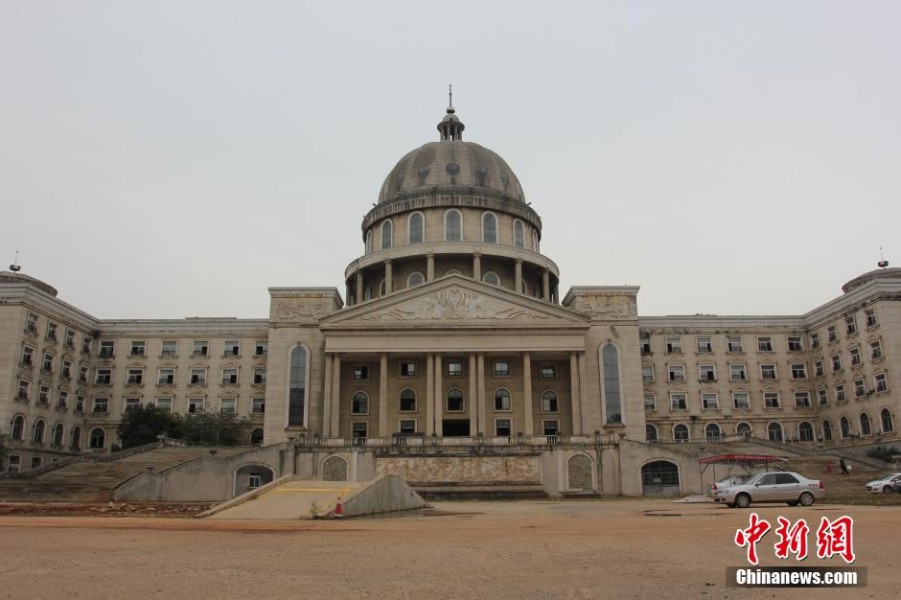
Where Is This Building? A Hint: Not in Washington, DC

One complete, one unfinished

Fake Stuff

China is getting more influence worldwide, but its still no match for the United States. Perhaps China is hoping to be able to exert symbolic control over US politics by not just having one copy of the US Capitol Building, but two — both in the same city.

Recent Chinese media reports show that one of the fake US Capitol Buildings in Wuhan, Hubei has fallen into disrepair after being abandoned when funds ran out before it could be completed (seen above in the gallery). While its similarity to the Wasington institution may be a coincidence, Chinese media have drawn a direct comparison by calling the Wuhan US Capitol Building a shanzhai (山寨) version, meaning “fake” or “counterfeit”.

With its interior still left to be finished, the fake five-story US Capitol Building was designed to be a hotel, and is shaped like a giant “U”. As with the authentic Capitol Building in Washington, this building sports a large, open round space topped by a dome.

Despite the tragedy of a dream left unfulfilled, Chinese enthusiasts of US political architecture need not be too upset as they are swimming in a rich pool of fake international landmarks. In fact, there is already a fake US Capitol Building that is completed and fully-functional in the same city (see in the gallery below).

The Wuhan Trade and Commerce Vocational School has as a faculty building that looks very similar to the US Capitol Building, but it;s not the only such imitation on campus grounds. Also seen at the school are a library in the shape of a pyramid as well as an accompanying sphinx, an Arc de Triomphe, as well as several Greek statues surrounding a water pool.

Can’t keep track of all these white buildings with pillars? Here’s a photograph of the real US Capitol Building for reference:

If it appears that China’s economy is not robust enough to support the building of two counterfeit US Capitol Buildings, but it is vibrant enough to build two fake Sphinx, a fake Louvre pyramid as well as localized fake versions of Tianan’men Square and the Great Wall of China.

Whether they be raw knock-offs or venerable homages to their original inspirations, the Chinese trend of copying things does not appear to be ending soon.

Source: People's DailyChinaChina,163 NewsSCOLFangChina News10 YanSTNNTuniu

Photos: People's DailyChinaChina,163 NewsSCOLFangChina News10 YanSTNNTuniu

Tags: Capitol BuildingCapitol Hill,CounterfeitFakefake landmarks,Shanzhai

Charles Liu

The Nanfang's Senior Editor

More stories

https://thenanfang.com/china-fake-us-capitol-building-wuhan-hubei/

Govt targets antitrust campaign at SMEs as new law looms

Over 98 percent of companies in Hong Kong are SMEs that lack legal knowledge and might easily fall into a position that breaches the law, Stanley Wong says. Photo: HKEJ

The government is launching a campaign to educate small and medium-sized enterprises (SMEs) about the Competition Ordinance, which will take effect next month, the Hong Kong Economic Journal reported Tuesday.

Competition Commission chief executive Stanley Wong said over 98 percent of companies in the city are SMEs that lack legal knowledge and might easily fall into a position that breaches the law.

The commission has put together some hypothetical cases in a manual that demonstrates four major types of anticompetitive practices that are prohibited by the new law.

These practices are price collusion, output control, market allocation and bid rigging.

Wong called on SMEs to review the conduct of their business to acknowledge their risks in this area and impose any precautionary measures to mitigate those risks.

The commission will unveil details of the enforcement of the law by the end of this year, together with the progress it has made in its studies of building renovations and the oil and gas markets.

The commission chief did not say which sectors will be the key targets in enforcement of the law.

[Chinese version中文版]

– Contact us at english@hkej.com

VW/DY/FL

http://www.ejinsight.com/20151103-govt-targets-antitrust-campaign-smes-as-new-law-looms/?utm_source=rss&utm_medium=rss&utm_campaign=20151103-govt-targets-antitrust-campaign-smes-as-new-law-looms

US investigating China-linked radio network

G&E Studio CEO James Su (seen here during the Boao forum earlier this year), is said to control the airtime on at least a dozen US radio stations. Photo: Reuters

US authorities are investigating a California company whose radio broadcasts are suspected to be backed by an entity controlled by the Chinese government.

The Federal Communications Commission (FCC) and the Justice Department launched the probe in the wake of a Reuters report Monday that revealed the existence of a covert radio network that broadcasts in more than a dozen American cities.

“Based on reports, the FCC will initiate an inquiry into the facts surrounding the foreign ownership issues raised in the stories, including whether the Commission’s statutory foreign ownership rules have been violated,” FCC spokesman Neil Grace said.

The California firm is owned by James Su, a naturalized US citizen born in Shanghai.

Reuters reported Monday that Su’s company, G&E Studio Inc, is 60 percent owned by a subsidiary of Chinese state-run radio broadcaster China Radio International (CRI).

Under US law, the FCC prohibits foreign governments or their representatives from holding a radio license for a US broadcast station.

Through G&E and some other entities, Su owns, co-owns or has leased virtually all the air time on at least a dozen US stations, including one operates in Washington, according to Reuters.

The stations carry G&E content, which is produced largely by his West Covina, California studios or by CRI in Beijing.

The news programming on these stations sticks closely to the Chinese government line on a host of issues, including the current military standoff in the South China Sea between China and the US.

US law requires anyone inside the country seeking to influence American policy or public opinion on behalf of a foreign government or group to register with the Justice Department.

Public records show that neither Su nor his companies are registered as foreign agents under the law, called the Foreign Agents Registration Act, Reuters said.

– Contact us at english@hkej.com

CG/RC

http://www.ejinsight.com/20151103-us-investigating-china-covert-radio-network/?utm_source=rss&utm_medium=rss&utm_campaign=20151103-us-investigating-china-covert-radio-network

US Navy plans more patrols in South China Sea

US Navy personnel participate in an exercise on a guided missile destroyer in the South China Sea. Credit: Reuters

The US Navy plans to conduct patrols within 12 nautical miles of artificial islands in the South China Sea at least twice per quarter, Reuters reported, citing an unidentified American defense official.

The patrols are aimed at reminding China and other countries about Washington’s rights under international law, the official was quoted as saying Monday.

“We’re going to come down to about twice a quarter or a little more than that,” said the official.

“That’s the right amount to make it regular but not a constant poke in the eye. It meets the intent to regularly exercise our rights under international law and remind the Chinese and others about our view.”

US Deputy National Security Adviser Ben Rhodes, meanwhile, also said Monday that there would be more demonstrations of the US military’s commitment to the right to freely navigate in the region.

“That’s our interest there … It’s to demonstrate that we will uphold the principle of freedom of navigation,” Rhodes was quoted as saying at a media forum.

His comments came a week after a US guided-missile destroyer sailed close to one of Beijing’s man-made islands in the South China Sea.

China’s naval commander last week warned that a minor incident could spark war in the South China Sea if America does not stop its “provocative acts” in the disputed waterway.

– Contact us at english@hkej.com

CG/RC

http://www.ejinsight.com/20151103-us-navy-plans-more-patrols-in-south-china-sea/?utm_source=rss&utm_medium=rss&utm_campaign=20151103-us-navy-plans-more-patrols-in-south-china-sea

Fake Starbucks text could be phishing scheme, experts warn

In a Facebook post, Starbucks denies having anything to do with the WhatsApp text message. Photos: Bloomberg, Facebook

Internet security experts have warned netizens against a fake Starbucks text message circulating on WhatsApp thatoffers a US$500 voucher purportedly from the coffee chain to anyone who will take its survey.

The message could be a phishing scheme aimed at obtaining the personal information of those who click on the message’s link, Headline Daily reported on Tuesday.

Warren Wang, one of those who received the message, “Take a one minute survey to get a US$500 Starbucks voucher”, made an enquiry at Starbucks to determine if what it says is true.

Starbucks Hong Kong said on its Facebook page that the company is not holding such a survey or promotional activity.

The firm is investigating the source of the text message, although it has no estimate as to the number of people so far affected.

It said its promotional activities and public announcements are published on its Facebook account.

Francis Fong, chairman of the Hong Kong Consumer Electronics Alliance, warned that various messages have been circulating on the internet and mobile messaging platforms such as WhatsApp inviting people to join a survey or take advantage of a promotional offer.

However, once users click on the link, they may be opening themselves up to a Trojan virus that could invade the Android or iOS system on their smartphone, Fong said.

Even if the link is safe, risks still remain as hackers could steal their personal information such as name, phone number and address, he said, adding that users must ascertain the source of such messages.

– Contact us at english@hkej.com

KZ/AC/CG

http://www.ejinsight.com/20151103-fake-starbucks-text-could-be-phishing-scheme-experts-warn/?utm_source=rss&utm_medium=rss&utm_campaign=20151103-fake-starbucks-text-could-be-phishing-scheme-experts-warn

Summary: all you need to know about the HKU whistleblowing controversy

By Thomas Chan November 3, 2015 / 10:32 HKT

The HKU whistleblowing controversy seems to be getting more complicated with each passing day. For those of you having trouble keeping up, we've compiled this little summary and done our best to unravel the squabble.

The controversy started when scholar Prof Johannes Chan was barred – and ultimately rejected – from taking the post of Pro-Vice Chancellor at the university earlier this year. The pro-democracy professor told HKEJ that he was unanimously nominated by the university's Human Resources team back in December 2014 and expected his inauguration in March 2015.

Student bodies and protesters stormed into a university council meeting, however, after hearing that Chan’s appointment was curbed by the government body on July 28, 2015. It was then that council member Dr. Lo Chung-mau performed his infamous “fake dive” that became an instant meme sensation on the internet.

Prof Chan’s appointment as Pro-Vice Chancellor was then officially rejected on September 29 after another council meeting. Billy Fung, chairman of the university’s student union and student representative to HKU Council, was then a naughty boy as he released a statement on Facebook revealing what he said were the reasons behind the decision, breaching the council’s confidentiality regulations.

According to the statement, pro-Beijing council member Arthur Li said Chan’s previous appointment as HKU’s Dean of Law was merely for “being a nice guy”, where two other members accused Chan as being too “high profile” and therefore should not be considered as a “senior manager of an enterprise”. 

FYI, a recent poll by the HKU student union found around 90 percent of respondents opposed Li's appointment within the University "of any kind", while 95 percent believe that the post of Council Chairman should be appointed to someone acceptable to academics, staff and students.

Dr. Lo Chung-mau, the “fake dive” guy, accused Chan for “not showing sympathy” when he fell (diddums!), and one Martin Liao said Chan’s academic writings have only been searched for on Google Scholar four times in the past five years (ooooh, snap!).

Commercial Radio later released a full recording of Li’s speech (recorded by no-one knows who), mocking Chan as a party secretary from the pan-democratic camp, and said he was very uncomfortable and very uneasy with this candidate.

Another leaked recording revealed council member Leonie Ki’s criticism of Chan, saying he was “overtly and recklessly” discussing his candidacy. She was also heard accusing Chan of “manipulating the press” to coerce others into approving him, reports the Hong Kong Free Press

Other council members were quick to criticise Fung’s whistleblowing actions. Despite lacking a disciplinary mechanism, the council voted to bar Fung from attending further meetings on reserved items on upcoming agendas. Council Chairman Edward Leong criticised Fung for bringing an “uneasy environment” by his “breach of confidentiality”.

Fung retaliated by saying his council member status was stripped without legal consultation, calling them out for “placing verdict without trail”, and claiming that the council was ultimately excluding people with opposing views.

The university has now obtained aCourt Order to ban members of the media from further disclosing leaked information of the meetings, which was quickly met with objections from seven journalism unions. Critics slammed the university's decision as ridiculous and failing to address Chan's controversial rejection, and feared such gagging order could potentially apply to all future council meeting coverage. 

You got it now? Clear as mud, right. 

Photo: Prof Johannes Chan via Wikipedia

http://hongkong.coconuts.co/2015/11/02/summary-all-you-need-know-about-hku-whistleblowing-controversy

Top Xinjiang Editor Expelled From China's Communist Party For 'Opposing Party Line'

Radio Free AsiaToday, 5:50 AM

Authorities in China's troubled northwestern region of Xinjiang have expelled the former editor of an official regional newspaper for failing to toe the line set down by the ruling Chinese Communist Party in Beijing, his former paper reported on Monday.

Zhao Xinwei, 58, former editor-in-chief of party's regional Xinjiang Daily newspaper, now faces prosecution after being investigated for "serious violations of discipline," the paper said.

While the phrase usually refers to corruption, there are signs that Zhao has also fallen foul of new party rules forbidding members and officials to say anything that isn't in accordance with policy as laid down by the leadership in Beijing.

Zhao is accused of "improper discussion" of party policies in Xinjiang and of making "public comments opposing" central government policy in the region, which has seen a string of violent incidents in recent years which critics say are the result of oppressive policies targeting the region's mostly Muslim Uyghur group.

"[His] words and deeds were not in line with the center or regional party committee," the paper said, citing infringements over issues of principle such as opposition to "separatism," "violent terrorism," and "religious extremism."

Prosecution likely

Zhao is also accused of abusing his position, squandering public funds, taking gifts, and embezzling money, the report said.

He will likely face prosecution after his case is "handed over to judicial authorities," it said.

Zhao, a Han Chinese from the northern province of Shanxi, took up his post at theXinjiang Daily in January 2011 and also chaired its Communist Party committee.

He had previously served as propaganda chief in the Silk Road city of Kashgar in the south of the region.

One of Zhao's subordinates, surnamed Fan, said Zhao had been replaced by an editor flown out from Communist Party mouthpiece the People's Daily in Beijing.

"All that is being made public at this time is [Zhao's] ideological orientation, that problems resulted from his haphazard misreading of central government documents, which caused instability in Xinjiang," she said.

"Those are the charges against him."

Corruption not the point

Fan said the news of Zhao's disgrace had been sent out as a syndicated text for media outlets across China to use.

But she added: "In actual fact, this so-called misinterpretation is meaningless. He published stuff that a party newspaper isn't supposed to publish; it's as simple as that."

She said the corruption investigation wasn't the main driver of Fan's fall. "No one is talking about that," she said.

But she declined to comment on the validity of the charges.

"I don't know him very well ... so it's hard for me to comment on him as a person," she said.

An employee who answered the phone at theXinjiang Daily also declined to comment.

"We don't know. We read it in the newspaper too," the employee said. "Who would tell us such a thing? You know as much as we do."

Ousted under new rules

A highly-placed Chinese media source said Zhao is the first high-profile party member to be ousted under the new rules.

"There's a lot of interest, and everyone wants to know exactly what the offending content was," the source said. 

"But this is very sensitive, dealing with Xinjiang, and so there is very limited official information ... We can never write about it."

"This is the first case of a party official [being sanctioned for] going off message; the first time I've heard of such a thing," the source said. "I have asked around, but nobody's talking."

Last week, the Communist Party issued a code of conduct for its 60-some million members in a bid to clamp down on internal factions and prevent its officials from going off-message in public.

The rules list eight moral and ethical principles that party members are expected to live by.

Featured on the list of banned behaviors are "forming party cliques," "contravening central party policy," and "using political power to seek profits for family members and staff."

They are aimed at preventing extravagant wining, dining, and golf, as well as "improper sexual relations" with anyone, as well as the formation of party cliques and factions that go against the leadership's political line, the official Xinhua news agency reported.

Divisions now common

But according to Guangzhou-based political commentator Ye Du, prosecuting officials for holding independent views is likely to be self-defeating in the long term.

"We have had more than a decade of the Internet and the awakening it brings, and it is very common to see internal divisions within party ranks now," Ye said.

"Even within the party elite with their vested interests—and the whole party has vested interests-—we can see various differences," he said. "How are they going to manage to maintain ideological unity?"

"Even if they make the boundaries clearer, this will still be a major challenge, one that will get progressively more challenging."

Anhui-based dissident Shen Liangqing said the party can't afford the slightest hint of dissent on the sensitive topic of Xinjiang.

"Things are likely to get worse and worse in this respect, because this whole going off message campaign could explode," Shen said. "Tensions in Xinjiang are getting worse and worse, and they have no appropriate way of resolving them; they have to rely on suppression."

"Actually the people targeted may have very moderate views, perhaps slightly different opinions about how to deal with the problem," he said. 

"If they require everyone to toe the party line, then Uyghurs will only have revolt left as a way of expressing themselves."

Tigers and flies

Since taking power in 2012, Chinese president Xi Jinping has launched an ongoing anti-corruption campaign targeting high-ranking "tigers" along with low-ranking "flies."

The party's internal investigative arm, the Central Commission for Discipline Inspection (CCDI), generally begins any probe into alleged wrongdoing by officials behind closed doors.

Rights lawyers have slammed the CCDI system as unaccountable and lacking in legal representation for those accused, as well as resorting to torture and other abuses to elicit forced confessions.

And political commentators have said the anti-corruption campaign is highly selective, with members of factions other than Xi's most likely to be targeted.

Reported by Ka Pa and Dai Weisen for RFA's Cantonese Service and by Yang Fan for the Mandarin Service. Translated and written in English by Luisetta Mudie.

http://www.rfa.org/english/news/uyghur/editor-11022015153453.html

China's New Crimes Will Stifle Public Expression, Erode Channels of Complaint

Radio Free AsiaToday, 1:01 AM

New amendments recently in force to China's criminal law have added more than 20 crimes to the statute book, including many critics say could further erode freedom of speech and place even more power in the hands of the state.

The amendments, effective Sunday, make it a crime to 'insult a judge,' 'disrupt court order,' post 'rumors' online and cheat in exams, while scaling back the death penalty on some crimes.

New criminal offenses include "fabricating, deliberately transmitting false information" online, "incitement to terrorism and extremism," and "preparing for an act of terrorism."

"Forcing someone to wear extremist clothing or tokens" is also listed, which follows a lengthy campaign to prevent the mostly Muslim Uyghur ethnic group from wearing veils, beards or other traditional clothing.

"Disrupting the work of public bodies" and "organizing or aiding illegal gatherings" are among the new crimes, which could be used to target rights activists and petitioners who complain against the government.

Meanwhile, China's embattled legal profession could be further hampered by the addition of crimes such as "disrupting order in a court" and "reporting or revealing information about cases not made public."

Anyone bringing a civil case based on "a distorted version of the truth" could face three to seven years in prison, which could affect the thousands of petitioners who lodge complaints against official wrongdoing daily.

And in a bid to tackle rising academic fraud, exam cheats may be jailed for three to seven years.

Targeting public expression

Online freedom of speech activist Wu Bin said many of the new crimes appear to target freedom of public expression.

"The purpose of adding these crimes is to forestall any protesting voices and to stifle freedom of expression among ordinary people," Wu told RFA.

"This is what they are legislating for ... there isn't a single crime that is aimed at officials," he said.

Guangzhou-based commentator Ye Du agreed. "They want to carry out thought-purification using the law, and totally wipe out any voices on the Internet," he said.

"They want to bring the entire Internet under the control of the government and the party," Ye said.

Xinjiang-based rights activist Hu Jun said a number of the newly designated crimes are poorly defined, meaning they can easily be exploited to justify detaining anyone the authorities don't like.

"The things they mention here are all extremely vague, making it so easy to bring these charges against someone," Hu said.

"There is a lot of messed up logic and ridiculous thinking in the Chinese Communist Party," he said.

No rule of law without change

Sichuan-based rights activist Huang Qi, who founded the Tianwang rights website, said large numbers of ordinary Chinese protesting over forced evictions and land grabs might well accuse the government of "terrorism."

"Such actions are never officially designated terrorism, but from the point of view of ordinary people, forced evictions and land grabs are acts of terrorism," Huang said.

Beijing-based rights lawyer Chen Jiangang said he holds out scant hope for any rule of law in China in the absence of systemic political change.

"There will be no rule of law without a change in the system," Chen said. "Our laws exist on paper only, because China has no judicial independence, and without it there are no checks and balances."

"The government decides the limits of the laws, then it announces them, and it also enforces them," Chen said. "Now there are no channels for the redress of grievances, and no channels for people to seek help."

"If the power of the state comes for you, they can send you straight to prison."

Reported by Yang Fan for RFA's Mandarin Service and by Hai Nan for the Cantonese Service. Translated and written in English by Luisetta Mudie.

http://www.rfa.org/english/news/china/crime-11022015114416.html

The devil's in the detail: Hong Kong musicians alarmed at MTR's permit scheme for carrying large instruments on trains

OLIVER CHOU

PUBLISHED : Tuesday, 03 November, 2015, 12:51am
UPDATED : Tuesday, 03 November, 2015, 12:51am


Head of Operation of MTR Francis Li updates the details of a "Trial Registration Scheme for Carriage of Oversized Musical Instruments" in October. Photo: Felix Wong

A new permit issued by the MTR to allow large musical instruments to be carried on its trains contains "insulting" terms and poses problems for everything from insurance to rehearsal times, arts executives and musicians said yesterday.

The rail operator launched the trial scheme yesterday after a review following an outcry over cases of musicians being ordered off trains. People can apply for permits to carry instruments longer than 130cm, the usual maximum for luggage on the MTR, but no longer than 145cm.

Permit applications will take seven working days to process, but the outcry was instant.

READ MORE: Bassist prejudice: Hong Kong's MTR eases ban on cellos, larger musical instruments still not allowed

"The devil is in the detail, and I think it is a trap for anyone to sign and agree to the terms under the trial registration scheme," said Ada Wong Ying-kay, a solicitor-turned-arts-advocate and adviser to the West Kowloon Cultural District Authority.

One clause, for example, says MTR officials have the right to check the instrument and ask the permit holder to prove their identity. But, Wong said: "An instrument is the personal asset of an individual. He or she can allow anyone to borrow it or use it. No authority can deny that right.

"We really cannot allow a public transport provider to continue to insult people like this. If this logic is followed, all over-sized luggage must follow the same registration route which is of course absurd. We will be an international joke."


Richard Bamping, principal cellist of the Hong Kong Philharmonic. Photo: Edward Wong

An MTR spokesman replied: "The scheme is a special arrangement outside the normal dimension rule … Registered users … would need to abide by certain safety guidelines and terms and conditions. We appeal to the public for their understanding."

Musicians were also dubious.

"I will not be registering. I can't agree to the conditions - my cello would not be insured under the conditions the MTR has required," said Richard Bamping, principal cellist of the Hong Kong Philharmonic since 1993. Under term four of the permit, the MTR is exempted from liability for any damage caused to an instrument in the course of the checks its staff are empowered to carry out.

Bamping was also troubled by a ban on carrying instruments between 8.15am and 9.15am: "I have used the service with my cello frequently for the past 23 years with no problem but if I'm forced to agree to only travel at certain times, and allow any employee of the company to remove my belongings from my hand and do with them as they see fit, it's too much hassle."

Cellists typically started rehearsals at 10am, meaning they faced being late or leaving home extremely early, said a Hong Kong Sinfonietta player.

"It is a shame for a service provider like the MTR to make life difficult for us - who are subsidised by the government to make music - and it is the same government that does not allow us to travel to work," the cellist said.

http://m.scmp.com/news/hong-kong/economy/article/1875119/devils-detail-hong-kong-musicians-alarmed-mtrs-permit-scheme

Hong Kong man stabbed fellow villager to death in front of mahjong players, court told

CHRIS LAUchris.lau@scmp.com

PUBLISHED : Tuesday, 03 November, 2015, 12:06am

UPDATED : Tuesday, 03 November, 2015, 12:06am

A postmortem examination revealed that Liu Wing-sang died of a wound to his heart, one of 27 on his body. Photo: SCMP Pictures

Mahjong players at a rural store looked on as a man stabbed a fellow villager to death, the High Court heard yesterday.

At least two witnesses saw Liu Sun-kong, 54, knife Liu Wing-sang in the chest and waist in the shop in Sheung Shui Wai village, in the northern New Territories, on May 23 last year, prosecutor John Dunn alleged.

A postmortem examination revealed that Liu Wing-sang died of a wound to his heart, one of 27 on his body.

READ MORE: Three South Asian men treated for knife wounds after being attacked on Hong Kong MTR platform

Dunn said there was bad blood between the two families, and in 2009 Liu Wing-sang had been charged with assaulting Liu Sun-kong.

Liu Sun-kong did not deny causing the victim's death but claimed he was provoked.

Under caution he told the police: "He beat me up a few times. I was simmering with rage so I took him out."

He pleaded not guilty to one count of murder.

Dunn said witness Tse Hok-wing, who was playing mahjong at the Ngau Kee Store that night, suddenly saw the bleeding victim rush into the premises, closely followed by the defendant.

"Tse saw the defendant was holding a knife in his right hand, which he used to stab at [the victim's] waist," Dunn said.

READ MORE: Psychiatric tests ordered on Hong Kong man accused of stabbing mother with scissors

Another witness, Liu Yuk-wah, who was also playing, saw the defendant stab the victim in the chest and abdomen.

The offence took place in Mun Hau Tsuen and Wai Loi Tsuen in Sheung Shui Wai village, home of the indigenous Liu clan.

The defendant disappeared after the attack but was later arrested by police with a blood-stained knife in his shoulder bag.

The court also heard that the defendant was seen beating the victim at a village entrance and public toilets before chasing him to the store.

Dunn asked the jury to consider whether it was possible that the defendant had been so provoked that he had lost his self-control.

The trial continues today before Mr Justice Kevin Zervos.

http://m.scmp.com/news/hong-kong/law-crime/article/1875113/hong-kong-man-stabbed-fellow-villager-death-front-mahjong

Hong Kong's High Court to rule on whether police can seize mobile phones

SAMUEL CHANsamuel.chan@scmp.com

PUBLISHED : Tuesday, 03 November, 2015, 12:01am

UPDATED : Tuesday, 03 November, 2015, 12:00am

Civil Human Rights Front convenor Daisy Chan Sin-ying (centre) said arrested members were told their phones were seized to help police investigations. Photo: K.Y. Cheng

The High Court will decide whether police officers have the authority to seize the mobile phones of people they arrest and access the content, after an application for a judicial review was granted.

The Civil Human Rights Front, an alliance of pro-democracy groups that organises the annual July 1 march, sought court clarification after police arrested five members and seized their phones.

The members were arrested on suspicion of breaching the conditions of a notice of no objection to last year's march - issued by the police - and obstructing officers.

READ MORE: Police scammer: Hongkongers suspicious of text message warning them to be wary of phone scams

Police accused the five of leading the march "too slowly".

Hectar Pun Hei SC will represent the plaintiff, Sham Wing-kan, when the two-day hearing opens tomorrow.

"We are seeking this judicial review because it affects not just the five of us," said Daisy Chan Sin-ying, convenor of the group.

Chan said they were told their phones were seized because it would help the police investigation. But when police told them in March that the investigation was over with no charges pressed, it turned out their phones were never accessed.

The legislation in question - section 50 (6) of the Police Ordinance - says officers can "search for and take possession of any newspaper, book or other document ... and any other article or chattel" found on anyone apprehended if a police officer "may reasonably suspect [it] to be of value to the investigation".

READ MORE: Chinese police post photo of man taking selfie from the boot of moving car

Describing the law as "archaic", Johnson Yeung Ching-yin, one of the five, said a smartphone was of a different nature than the items named in the law.

"A smartphone may contain access to social-media platforms, personal information of others or even pictures of a very private nature," Yeung said.

"It would be a disproportionate infringement of privacy if the police can demand access only on the grounds of 'reasonable suspicion'."

http://m.scmp.com/news/hong-kong/law-crime/article/1875053/hong-kongs-high-court-rule-whether-police-can-seize-mobile

Hong Kong pan-democrats fear election clashes with 'umbrella activists' will split pro-democracy vote

JOYCE NGjoyce.ng@scmp.com

PUBLISHED : Tuesday, 03 November, 2015, 12:01am

UPDATED : Tuesday, 03 November, 2015, 12:00am

Sin said clashes could split the pro-democracy vote. Photo: Felix Wong

Four major pan-democratic parties say one-third of their 158 candidates running in this month's district council elections are facing challenges from self-proclaimed "umbrella activists" and former party members.

The parties fear the clashes will split the pro-democracy vote and so hand victory to pro-establishment rivals.

They said the situation was reflected in the fact that many pro-establishment candidates had turned down media invitations to speak at election forums.

READ MORE: Hong Kong pan-democratic lawmakers urge more government funding for next year's Legco election campaign

At a media gathering yesterday, the Democratic Party, Civic Party, Labour Party and the Association for Democracy and People's Livelihood issued a list of 46 candidates facing competition from those who claim to share their democratic ideals.

"These candidates clashing with us have a lot of other choices," said Democrat Sin Chung-kai, who oversees his party's campaigns. "There are a total of 431 seats, and pan-democrats are contesting less than half … Why don't they challenge the 68 uncontested seats held by the pro-Beijing camp?"

The figure did not include new candidates "who have worked in the districts for a long time," Sin said. "We only counted those parachuted into the constituencies."

Civic Passion leader Wong Yeung-tat said his group saw Democrats as "pro-establishment". Photo: Felix WongThe Democrats are fielding 95 candidates, the most among the four parties. Many candidates have refused to join a system set up among the pan-democratic parties to avoid clashes. They come from several groups including Civic Passion, which has five out of its six candidates running against Democrats.

Also refusing to join were Youngspiration and a group whose Chinese name roughly translates as New Youth Group.

Five candidates from other groups in clashes are former Democratic Party members.

Earlier, Civic Passion leader Wong Yeung-tat said his group saw Democrats as "pro-establishment". Youngspiration said its candidates had been unaware Democrats were running in the same neighbourhoods.

The four pan-democratic parties said only one of their candidates - Albert Ho Chun-yan - had had a chance to take on a pro-establishment rival face to face at a forum because so many of them had turned down media invitations to speak.

http://m.scmp.com/news/hong-kong/politics/article/1875054/hong-kong-pan-democrats-fear-election-clashes-umbrella

Workers can be personally liable for violations of coming competition law, Hong Kong Competition Commission chief says

NAOMI NGnaomi.ng@scmp.com

PUBLISHED : Tuesday, 03 November, 2015, 12:01am

UPDATED : Tuesday, 03 November, 2015, 12:00am

Dr Stanley Wong, chief executive of the Competition Commission, said violations of the law could be as seemingly innocent as salespeople discussing and agreeing with their competitors on prices, or restricting volumes of goods. Photo: May Tse

The head of the city's competition watchdog has warned that company employees who engage in conduct in violation of the coming competition law will be held personally liable in addition to any liability incurred by employers under the legislation.

"The reality is, even if you're a low-level salesperson, you may be personally liable," said Dr Stanley Wong, chief executive of the Competition Commission.

Wong said violations of the law could be as seemingly innocent as salespeople discussing and agreeing with their competitors on prices, or restricting volumes of goods.

READ MORE: Hong Kong competition law: advice for companies on staying within the new rules

Wong's warning came as the commission, the statutory body which investigates anti-competition practices, unveiled a toolkit for small and medium-sized enterprises to help them comply with the new law, which will be fully enforced from December 14.

Such companies account for more than 98 per cent of Hong Kong businesses, so Wong said they were a "major focus" of the body's advocacy and engagement plan.

A sales of a fitness centre proposes plans to her customers. Photo: Edmond So

The toolkit, which is available to download online, highlights four kinds of conduct that could be identified as high risk behaviour. These include price fixing, market sharing, output restriction and bid rigging.

There are certain exemptions for some businesses. If a case is not regarded as a serious violation, and the companies involved have a combined turnover of less than HK$200 million, they will not be liable under the first conduct rule in the law which prohibits businesses from making agreements with more than one party to prevent competition.

The second conduct rule, which prohibits anti-competitive conduct by a party with substantial market power, does not apply to businesses with a turnover of less than HK$40 million.

The commission advised companies to come up with a compliance policy, and provide training to "frontline" staff such as those involved in annual industry conferences or trade association meetings where competition discussions could take place.

"Companies have to try to bring home compliance on the personal level ... Don't think you can engage in loose talk," Wong said. "It's your risk; it's also the company's risk."

In June the commission distributed guidelines to over 500 trade associations.

http://m.scmp.com/news/hong-kong/economy/article/1875087/workers-can-be-personally-liable-violations-coming

Outdated rules give Hong Kong plumbers too much responsibility for complex projects, engineers' body says

NAOMI NGnaomi.ng@scmp.com

PUBLISHED : Tuesday, 03 November, 2015, 12:31am

UPDATED : Tuesday, 03 November, 2015, 12:31am

The Waterworks Ordinance stipulates that licensed plumbers are solely responsible for supervising projects, the Hong Kong Institution of Engineers stated. Photo: May Tse

The lead-in-water scandal has revealed that the Water Supplies Department's regulations governing licensed plumbers are outdated, according to a statutory body of professional engineers.

The Waterworks Ordinance stipulates that licensed plumbers are solely responsible for supervising projects - a practice that is no longer appropriate given the complexities of today's multimillion-dollar projects, the Hong Kong Institution of Engineers stated.

READ MORE: Plumbers face blacklist over Hong Kong lead-in-water scare as Carrie Lam defends civil servants' role in scandal

"It's about finding the right person to do the right job," Chan Chi-chiu, the institution's president, said yesterday.

"There is nothing [in the legal framework] to prevent somebody who has very little experience from taking charge of a very, very major project, and that's not healthy."

A resident of Kai Ching Estate fetches water from the newly installed temporary pipes. Photo: May Tse

Over the past few months, tens of thousands of residents at 11 public housing estates have found themselves at the centre of a contamination scare after excessive levels of lead were found in their drinking water. Blame for the scandal has shifted from licensed plumbers to water supplies contractors and to the government.

Although the government's task force investigation confirmed the problem was caused by solder material in pipe joints, there has still been no clarification as to who exactly should be held responsible.

There are around 2,900 licensed plumbers in Hong Kong, according to the Water Supplies Department. But they are only given one licence level, meaning it encompasses a very diverse group of workers with varying years of experience, and there are no constraints on what projects each plumber can take.

READ MORE: Better quality control and upgraded qualification system for plumbers might ensure safer Hong Kong drinking water

"There are many plumbers with many years of experience, and they should be honoured properly," said Peter Wong, a former president of the institution.

The institution, which released its findings in a report after setting up a task force to review the controversy, also proposed that the Housing Department should set up a certified list of subcontractors since under the current system plumbing contractors outsourced jobs to subcontractors themselves.

A judge-led commission of inquiry has begun substantive hearings into the scandal. It will hear testimony from witnesses including the housing minster, Professor Anthony Cheung Bing-leung, and Deputy Director of Housing Ada Fung Yin-suen.

http://m.scmp.com/news/hong-kong/health-environment/article/1875116/outdated-rules-give-hong-kong-plumbers-too-much

November 02, 2015

CY's wife defends daughter, pleads for privacy - RTHK

  • Regina Leung said her daughter was a kind-hearted little girl who loves animals. Photo: RTHK

    Regina Leung said her daughter was a kind-hearted little girl who loves animals. Photo: RTHK

The Chief Executive’s wife, Regina Leung, on Monday urged the media and the public not to disturb her daughter no matter how dissatisfied they are with society or the political system. 

She was speaking to the media about the incident at the nightlife hotspot, Lan Kwai Fong, on Halloween night when she was slapped by her 24-year-old daughter, Leung Chai-yan. The incident was widely shared on the social media. 

Regina Leung said Chai-yan was celebrating Halloween with friends at a restaurant but was followed by reporters. She said the situation was chaotic and she was called by Chai-yan’s friends to pick her up. She said scuffles started when some reporters tried to get into a car with her daughters. She said Chai-yan merely wanted to protect her friends. 

Asked about how she feels about being slapped by her daughter, Regina Leung said Chai-yan was drunk and didn’t mean to offend anyone. 

She described Chai-yan as a kind-hearted little girl who loves animals. She said her daughter needed rest.

The Chief Executive did not comment on the incident as he attended an event on Sunday.

http://news.rthk.hk/rthk/en/component/k2/1221130-20151102.htm

Engineers call for change in water supply rules - RTHK

  • Chan Chi-chiu (right), the president of the Institution of Engineers with his predecessor Peter Wong. Photo: RTHK

    Chan Chi-chiu (right), the president of the Institution of Engineers with his predecessor Peter Wong. Photo: RTHK

The government has been urged to implement a grading system for licensed plumbers to better regulate the water supply system. 

That's one of the proposals the Institution of Engineers made after a two-month study into the lead contamination saga. 

The engineers found that existing laws regulating water supply systems, the use of 
materials as well as plumbers are all very outdated, compared with British standards. 

The president of the Institution, Chan Chi-chiu, said the current single-plumber approach isn't good enough.

http://news.rthk.hk/rthk/en/component/k2/1221145-20151102.htm

Please back off and leave Chai-yan alone: Mother urges media after slaps in the street

LAI YING-KIT YINGKIT.LAI@SCMP.COM

PUBLISHED : Monday, 02 November, 2015, 6:23pm

UPDATED : Monday, 02 November, 2015, 6:41pm

Leung Chai-yan (left), 24, in Halloween make-up poses with her parents Leung Chun-ying and Regina Tong at Ocean Park, in a picture posted on her Instagram account. Photo: SCMP Pictures

The wife of Chief Executive Leung Chun-ying urged the media today to give their eldest daughter, Leung Chai-yan, more room as the 24-year-old needed rest.

Regina Tong Ching-yee was responding to a weekend drama that saw her photographed being slapped twice in the face on a Central street by her daughter – decked out in ghoulish attire and make-up for Halloween festivities.

The open altercation occurred as Tong was helping her board a taxi to leave the packed scene early on Sunday, according to a number of videos posted online.

When asked how she felt about the slapping, Tong said she believed her daughter was “tipsy” at the time and had no intention of offending anyone.

She also said there was “pushing” in the crowd amid chaos caused by up to 50 reporters surrounding Chai-yan and her friends.

“What Chai-yan wanted to do was to protect her friends and not let them be pictured by the media,” Tong said. “Chai-yan is a kind-hearted girl. She is keen to protect her friends.

“I believe she had no intention of offending anyone with her behaviour that evening.”

Read more: 'Nightmare at Lan Kwai Fong: Leung Chai-yan slaps her mother twice in Halloween street tantrum

In the videos, Chai-yan was recorded as telling the crowd: “You know this mum is not my actual biological mother.”

Tong did not comment on this statement.

Chai-yan’s friends had called her to the scene to help after they had difficulty leaving, she said.

But chaos set in immediately when she arrived in a car. She said up to 50 reporters surrounded her vehicle, with some even trying to open a door and rush in.

Leung Chai-yan (centre) arrives on the first day of the book fair at the Convention and Exhibition Centre in Wan Chai on July 15. Photo: May TseTong urged the media and internet users to give Chai-yan more space.

“What I want to say is … no matter how unhappy you are about the status quo and the current political system, Chai-yan is innocent. And so are her friends,” she said.

“Please do not disturb her, especially in her private activities. Her emotions … She needs rest.”

http://m.scmp.com/news/hong-kong/article/1875000/please-back-and-leave-chai-yan-alone-mother-tells-media-after-slaps

HKU injunction sets ‘bad example’ for press freedom, journalists warn, as university urged to withdraw court order

LAI YING-KIT YINGKIT.LAI@SCMP.COM

PUBLISHED : Monday, 02 November, 2015, 3:20pm

UPDATED : Monday, 02 November, 2015, 3:20pm

Journalists and teachers shout slogans at HKU on Monday. Photo: Dickson Lee

Seven groups of journalists and teachers today urged the University of Hong Kong to withdraw a court order which bars the media from disclosing discussion of the university’s council meetings.

Shouting slogans, representatives from the group gave a petition letter to an officer of the university today.

The groups included the Hong Kong Journalism Association, the Hong Kong Press Photographers Association, the RTHK Programme Staff Union, the Next Media Trade Union, Ming Pao Staff Association, the Independent Commentators Association and Journalism Educators for Press Freedom.

They said the injunction obtained by HKU dealt a severe blow to press freedom, and deprived the public of the right to know about an important decision by the HKU council.

The injunction bars media organisations from releasing audio recordings, papers and discussions of the HKU council. It came after Commercial Radio last week aired two audio clips featuring two council members discussing the appointment of law scholar Professor Johannes Chan Man-mun’s bid for a senior managerial position.

Hong Kong Journalists Association vice-chairwoman Shirley Yam said the injunction sought by HKU smothered the media from reporting issues of interest to the public.

“It set a very bad example. If other organisations follow suit in the future, the public will not be able to know important information,” she said.

Yam said the association was seeking legal advice to decide whether to make a plea when the matter returns to the High Court on Friday.

http://m.scmp.com/news/hong-kong/education-community/article/1874932/hku-injunction-sets-bad-example-press-freedom

Hong Kong lead-in-water scandal: Government unaware material used to solder pipes posed health risk, inquiry hears

EDDIE LEE EDDIE.LEE@SCMP.COM

PUBLISHED : Monday, 02 November, 2015, 4:15pm

UPDATED : Monday, 02 November, 2015, 6:12pm

Anthony Cheung did not state who should be held responsible for the tainted water scandal. Photo: Felix Wong

The construction industry and government were unaware of health risks posed by lead in material used to solder pipes before the outbreak of the tainted water scandal, Hong Kong’s housing chief said.

“With hindsight, had they been aware of the related risks, the Housing Authority and the Housing Department, I believe, would have put in place measures to prevent [lead from being used],” housing minister Professor Anthony Cheung Bing-leung, who also chairs the authority, today told a judge-led panel responsible for investigating the matter.

Tens of thousands of residents living in several public housing estates found themselves at the centre of a contaminated water scare after tests commissioned by the Democratic Party in June showed that samples taken from tap water at the Kai Ching Estate in Kowloon City contained amounts of lead exceeding World Health Organisation standards. Subsequent tests by the government showed water samples from a number of public housing estates also contained excessive amounts of lead.

READ MORE: Task force wraps up 4-month investigation into water scare at estates, confirming lead in pipe joints to blame

The imbroglio raised questions about the administration’s ability to ensure public health and the quality of public housing.

Loads of documents were being sent in. Photo: Felix Wong“The government never underestimated the risks from the outset,” said Cheung, as he gave evidence on the first day of the hearing.

”As soon as I was informed of [the results of the tests], I decided that we needed to enter into emergency mode. I also reported the matter to the chief secretary of the government.” But he added: “We did not want to cause a panic.”

The minister did not state who should be held responsible for the issue.

Nor did he specify whether all the water pipes in public housing estates built after 2005, when construction workers in the city began using lead in soldering material in connecting pipes, needed to be replaced.

Apart from Cheung, about 20 incumbent and retired housing officials, including one of the deputy directors of housing, chief architects and chief building services engineers responsible for the 11 public housing projects in question, will give evidence.

Three officials from the Water Supplies Department will also testify, including its director.

The two-man panel is chaired by High Court judge Mr Justice Andrew Chan Hing-wai, with former ombudsman Alan Lai Nin as commissioner.

The hearings are slated to continue into January.

http://m.scmp.com/news/hong-kong/health-environment/article/1874945/hong-kong-lead-water-scandal-government-unaware

Business mood among Hong Kong’s SMEs at lowest in 3 years, poll finds

PHILA SIU PHILA.SIU@SCMP.COM

PUBLISHED : Monday, 02 November, 2015, 5:09pm

UPDATED : Monday, 02 November, 2015, 5:09pm

More than 60 per cent of the interviewed small- and medium enterprises feels Hong Kong is in an “economic winter season”. Photo: Reuters

Fourth-quarter business sentiment among Hong Kong’s small- and medium-sized enterprises has dropped to its lowest in three years, according to an index released today.

The Standard Chartered Hong Kong SME Leading Business Index dropped 5.2 points from the third quarter of this year to 44.4. Readings below 50 indicate a pessimistic business sentiment and readings above 50 show optimism.

“Under the impacts of the volatile global economy, the strong Hong Kong dollar and economic slowdown in China, local SMEs are hard hit,” said Gordon Lo, director of business management at the Productivity Council, which conducted the survey.

“To ride out the adversity, SMEs should start with process innovation, by re-examining and streamlining their business processes and operation models in order to raise efficiency and seize new opportunities.”

The pollsters interviewed more than 806 SMEs between September and last month.

More than 60 per cent of the respondents agreed the city was in an “economic winter season”, while 24 per cent said the current business climate was worse than the financial crisis of 2008.

Among those who described the city’s economy as being in “winter”, 71 per cent did not have measures in place to address the challenges while 8 per cent planned to lay off staff.

http://m.scmp.com/news/hong-kong/economy/article/1874967/business-mood-among-hong-kongs-smes-lowest-3-years-poll-finds